
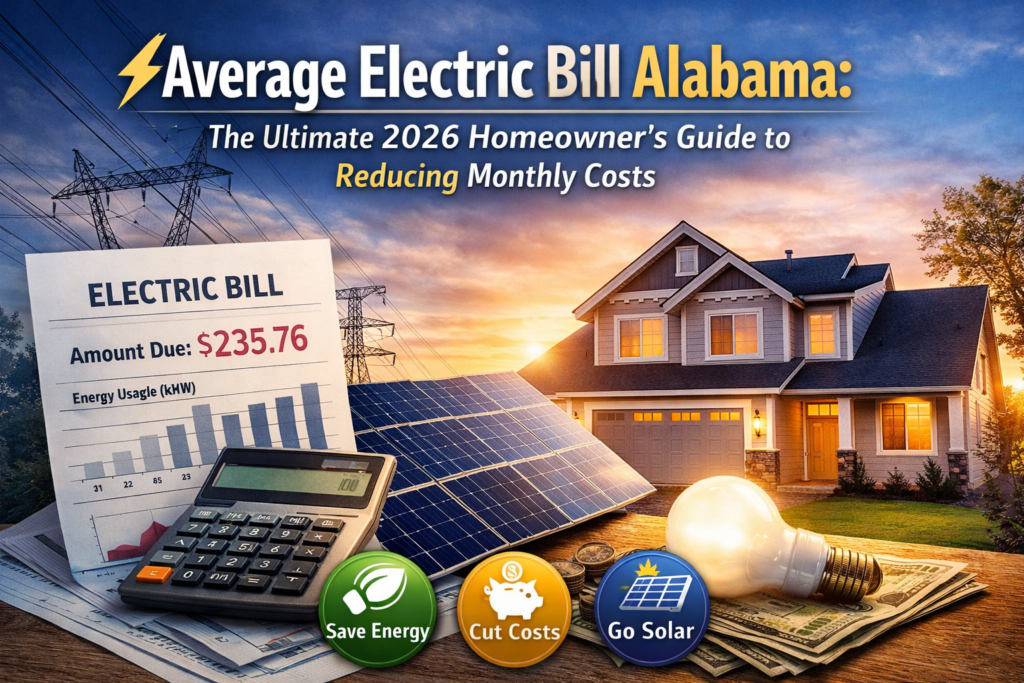
If you’re living in the heart of Birmingham or trying to keep your home cool in the humid summers of Huntsville, you’ve probably felt the sting of a rising utility bill. In Alabama, we don’t just deal with heat; we deal with that thick, heavy humidity that makes your air conditioner work overtime. Whether you’re getting your power from Alabama Power, Average Electric Bill alabama”Huntsville Utilities, or Dixie Electric, understanding your bill is the first step toward keeping your hard-earned money in your pocket.
As an energy specialist who has audited everything from the historic mansions in Montgomery’s Garden District to the modern smart homes in Madison, I’ve seen homeowners struggle with bills that fluctuate wildly. In this guide, I’m going to break down exactly what the average electric bill in Alabama looks like in 2025 and provide you with the exact strategies I use to help local families slash their costs by 30% or more.
1. The Reality Check: What is the Average Electric Bill in Alabama in 2025?
Most national statistics don’t account for the “Deep South Factor.” In Alabama, our energy needs are unique, and our bills reflect that.
Alabama Electricity Rates 2025: Breaking Down the Numbers
As we head into 2025, residential electricity rates in Alabama are averaging around 15.46 cents per kilowatt-hour (kWh). While this is close to the national average, Alabama residents often have some of the highest total bills in the country. Why? Because we consume a lot of energy—averaging about 1,100 to 1,200 kWh per month. This puts the average monthly bill in the range of $170 to $195 year-round, with summer spikes easily hitting $350+ in Birmingham and Montgomery
.
Why Birmingham and Huntsville Homeowners Face Unique Challenges
In Birmingham, the rolling hills and older housing stock in areas like Forest Park mean insulation is often an issue. In Huntsville, the rapid growth in Madison has led to larger homes that require massive amounts of cooling. Regardless of where you are, the “Humidity Tax” is real. When the air is wet, your AC has to work twice as hard to dehumidify before it can even start cooling the air.
The Major Players: Alabama Power vs. Huntsville Utilities vs. Co-ops
Most of Central and Southern Alabama is served by Alabama Power, while North Alabama relies on Huntsville Utilities (which buys power from TVA). Then you have the cooperatives like Dixie Electric serving rural areas around Montgomery. Each has different peak hours and rebate programs. Knowing your provider’s specific “Time-of-Use” options is the “secret sauce” to saving money in Alabama.
2. Reducing Electricity Costs Alabama: The “Deep South” Strategy
If you want to see a real drop in your bill, you have to attack the problem with local knowledge.
Time-of-Use Planning: Shifting the Load in Birmingham
Alabama Power and other local utilities are increasingly moving toward “Time-of-Use” (TOU) pricing. This means electricity is more expensive when everyone is using it (usually 2 PM to 7 PM during the summer).
•The Strategy: In Birmingham, I tell my clients to “Pre-Cool.” Set your AC to 72°F at noon, then bump it up to 78°F at 2 PM. Your home will stay cool through the expensive window without the AC compressor kicking on.
•The Impact: Shifting laundry and dishwashing to after 8 PM can save a typical Huntsville family $40 to $60 a month.
Smart Thermostats Benefits: Fighting the Alabama Humidity
A smart thermostat is your best friend in Montgomery. Devices like Nest or Ecobee don’t just manage temperature; they manage humidity. By using “dehumidification mode,” your AC runs more efficiently, making 75°F feel like 72°F. This small shift can reduce your cooling costs by 15% immediately.
Air Conditioning Energy Saving: The 20-Year-Old Unit Problem
If you’re living in a beautiful older home in Mountain Brook or Old Cloverdale, you might still have an AC unit from the early 2000s. These units are “energy hogs.” Modern high-efficiency heat pumps use 30-50% less electricity. In Alabama’s climate, a new unit often pays for itself in energy savings in less than 7 years.
3. The Solar Solution: Is Solar Panel Installation Alabama Worth It in 2025?
Alabama has plenty of sun, but the “Solar Landscape” here is different than in the West.
The ROI of Solar in the Heart of Dixie
While Alabama doesn’t have the same “Net Metering” laws as some other states, solar is still a viable option for long-term savings. For a home in Madison or Hoover, solar panels can provide a hedge against future rate hikes from utility companies.
Battery Storage: The “Storm-Proof” Benefit
In Alabama, we deal with severe weather and tornadoes. Adding a battery backup to your solar system isn’t just about saving money; it’s about “Resiliency.” When a storm knocks out power in Huntsville, your solar battery keeps your fridge and lights running.
4. Home Energy Management Alabama: Small Changes, Big Results
Home Energy Audit Alabama: Finding the Leaks in Montgomery
Before you buy new windows, get an audit. In Montgomery, many older homes have “attic bypasses”—small gaps around pipes and wires where your expensive cool air is leaking into the attic. Sealing these gaps is the cheapest way to lower your bill.
Energy-Efficient Appliances: The Energy Star Difference
Replacing an old “garage fridge” in Birmingham with a new Energy Star model can save you $10 a month alone. In a state with high usage, every appliance upgrade counts toward that $100/month saving goal.
Reducing Carbon Footprint Alabama: Clean Energy for a Greener State
By reducing your kWh usage, you’re helping reduce the load on Alabama’s power plants. Whether it’s shifting to LED lighting or improving your home’s “envelope,” you’re making a positive impact on our beautiful state’s environment.
5. Hyper-Local FAQ: Expert Answers for Birmingham, Huntsville, and Montgomery Homeowners
Q: Why is my electric bill so much higher in Birmingham than in other states?
A: It’s a combination of high usage due to humidity and the specific rate structures of local utilities. Alabamians use more electricity per capita for cooling than almost any other state.
Q: What are the peak hours for Alabama Power in the summer?
A: Generally, peak hours are Monday through Friday, 2 PM to 7 PM. Avoiding high-energy activities during this window is the best way to lower your bill.
Q: Does Huntsville Utilities offer rebates for energy-efficient upgrades?
A: Yes! Huntsville Utilities, in partnership with TVA, often offers rebates for heat pump installations, attic insulation, and smart thermostats. Always check their website before starting a project.
Q: How do I find a reputable energy auditor in Montgomery?
A: Look for auditors certified by BPI (Building Performance Institute). Many local contractors in the River Region offer these services, and some utilities provide basic audits for free or at a discount.
Disclaimer: Energy savings vary based on home size, age, and individual habits. Always consult with a licensed energy professional or your local utility provider before making major changes to your home’s electrical or HVAC systems.