
In the modern American household, electricity is the invisible lifeblood that powers everything from our home offices to our kitchen appliances. However, when this power malfunctions, it doesn’t just cause an inconvenience—it creates a life-threatening situation. Understanding what is an electrical emergency and knowing exactly how to handle it is the difference between a minor repair and a devastating house fire.what is an electrical emergency ? How To Handle To protect Your Home
According to the National Fire Protection Association (NFPA), electrical failures or malfunctions are a leading cause of home fires in the United States. This comprehensive guide is designed to provide homeowners with the critical knowledge needed to identify, manage, and prevent electrical emergencies, ensuring the safety of your family and the integrity of your property.
what is an electrical emergency ? How To Handle To protect Your Home Identifying the Crisis: What Is an Electrical Emergency?
Not every flickering light bulb requires a 911 call, but misdiagnosing a serious fault can be fatal. An electrical emergency is any situation where the electrical system poses an immediate risk of fire, electrocution, or significant property damage.
1. The Scent of Danger: Burning Plastic or Ozone
If you detect a fishy smell or the unmistakable scent of burning plastic near an outlet or the breaker panel, you are in the middle of an emergency. This indicates that the insulation on your wiring is melting due to extreme heat.
•The Risk: This is often the final stage before an active structure fire breaks out inside your walls.
2. Audible Arcing: Buzzing and Humming
Electricity should be silent. If your walls are “talking” to you with buzzing, sizzling, or popping sounds, you likely have a loose connection or a dangerous arc fault.
•The Risk: Arc faults can reach temperatures of over 10,000°F, easily igniting wooden studs and insulation.
3. Discolored Outlets and Warm Wall Plates
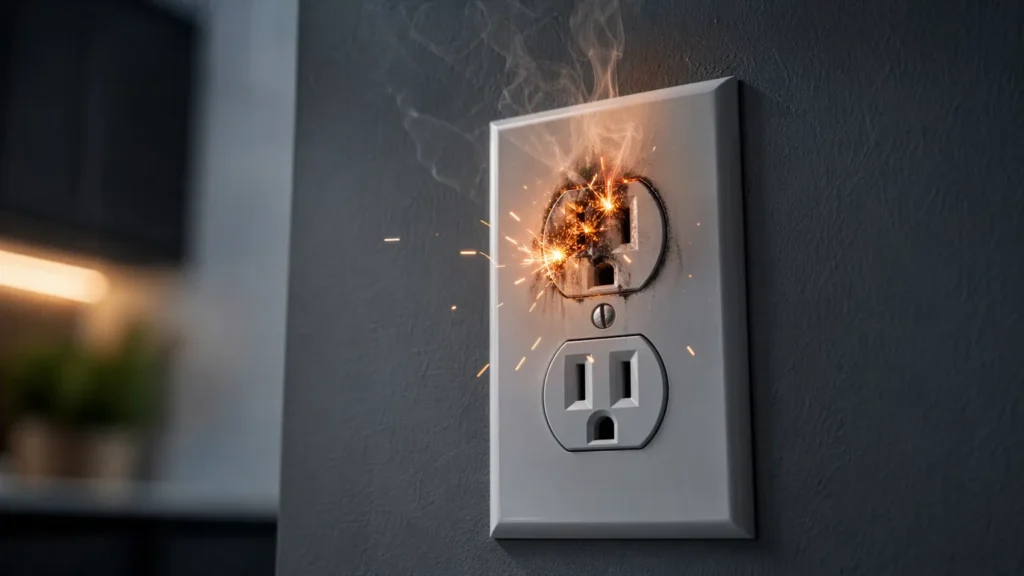
If you notice char marks, soot, or discoloration around the slots of a power outlet, or if the wall feels warm to the touch, the circuit is overheating.
•The Risk: This suggests a “glowing connection” where high resistance is creating a localized heat source.
4. Persistent Circuit Breaker Tripping
While a breaker tripping once might just be an overload, a breaker that trips immediately after being reset is a sign of a short circuit or a ground fault.
•The Risk: Forcing a breaker to stay on when it wants to trip can lead to catastrophic wire failure.
Immediate Action: How to Handle an Electrical Emergency
When a crisis strikes, panic is your worst enemy. Following a structured protocol can save lives.
Step 1: Cut the Power at the Source
If it is safe to do so, navigate to your Main Service Panel (Breaker Box) and flip the main 200-amp breaker to the “OFF” position. This de-energizes the entire house.
•Pro Tip: Never attempt to reach the panel if you have to stand in water or if the panel itself is sparking or smoking.
Step 2: Use the Correct Fire Extinguisher
If a small fire has started, NEVER use water. Water conducts electricity and will lead to a fatal shock. Use a Class C fire extinguisher, which is specifically rated for electrical fires.
•Standard: Look for the “C” label on your extinguisher. If you don’t have one, evacuate immediately.
Step 3: Evacuate and Call 911
If the situation involves smoke, fire, or a person who has been shocked, get everyone out of the house immediately. Once safe, call emergency services and then your local utility company.
Common Causes of Electrical Emergencies in US Homes
Understanding the “why” behind the emergency can help you prevent the next one. Many American homes, especially those built before the 1980s, face specific risks.
1. Outdated Wiring Systems (Knob and Tube / Aluminum)
Many older homes in the Northeast and Midwest still have Knob and Tube wiring or Aluminum wiring from the 1960s and 70s. Aluminum expands and contracts more than copper, leading to loose connections at outlets.
•The Danger: Loose connections are the primary source of arc faults.
2. Overloaded Circuits in the Digital Age
Modern families use significantly more power than previous generations. Plugging multiple high-wattage appliances (like space heaters, air conditioners, and gaming PCs) into a single circuit designed for 15 amps is a recipe for disaster.
3. Damaged or Frayed Power Cords
We often overlook the cords behind our furniture. A cord pinched by a heavy sofa can develop internal damage, leading to a short circuit.
The Role of AFCI and GFCI in Emergency Prevention
The National Electrical Code (NEC) now requires specific types of protection to prevent emergencies before they start.
AFCI: Arc Fault Circuit Interrupters
AFCIs are designed to detect the specific electrical signature of an arc—the “sparking” that happens when a wire is damaged. Unlike standard breakers, they trip before the heat builds up enough to start a fire.
GFCI: Ground Fault Circuit Interrupters
GFCIs are mandatory in “wet” areas like kitchens, bathrooms, and garages. They monitor the balance of current and trip if they detect that electricity is leaking to the ground (potentially through a person).
How to Create a Home Electrical Emergency Kit
Being prepared means having the right tools at hand. Every US homeowner should have an emergency kit that includes:
1.A High-Quality Flashlight: With extra batteries, kept near the breaker panel.
2.Non-Contact Voltage Tester: To check if a wire is live without touching it.
3.Class C Fire Extinguisher: Mounted in an accessible location.
4.Emergency Contact List: Including your utility company and a 24/7 emergency electrician.
When to Call an Emergency Electrician vs. 911
It is important to know who to call.
•Call 911 if: There is active smoke, fire, or someone has been injured by electricity.
•Call an Emergency Electrician if: You have lost power to critical systems (like your furnace in winter), you hear buzzing in the walls, or you smell burning but see no fire.
Conclusion: Proactive Safety is the Best Defense
An electrical emergency is a high-stakes situation that requires a calm, informed response. By upgrading your home to modern NEC standards, installing AFCI/GFCI protection, and knowing the warning signs of a failing system, you can protect your home from the devastating effects of electrical fires.
Don’t wait for the smell of smoke to take action. Schedule a professional electrical inspection today to ensure your home’s invisible lifeblood remains a source of comfort, not a source of danger.