
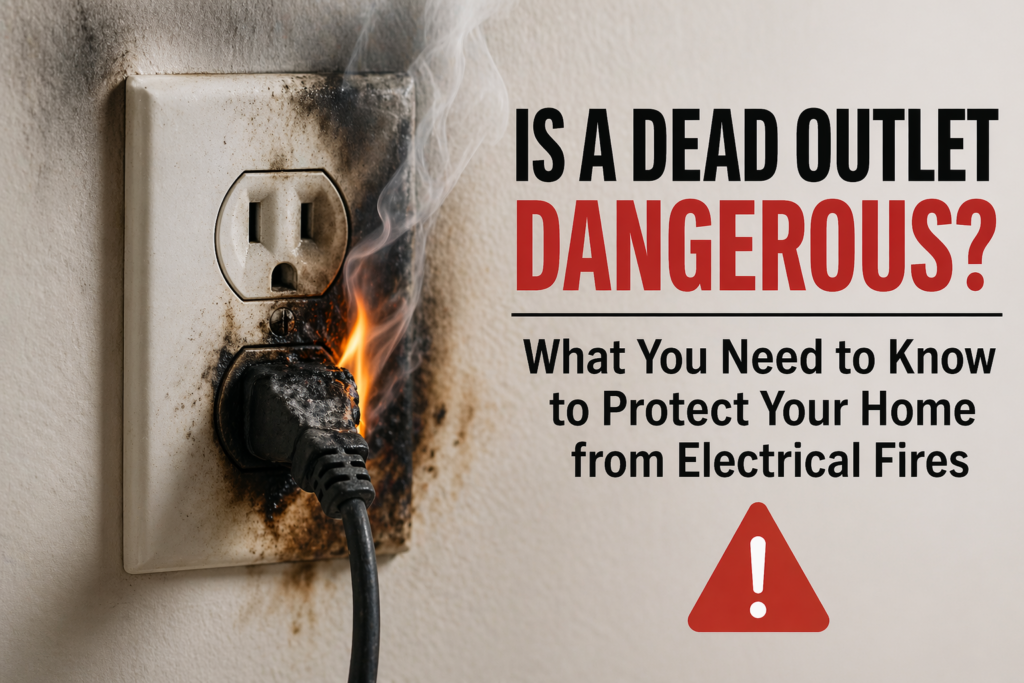
We’ve all been there. You go to plug in your phone or the vacuum cleaner, and… nothing. You try the other plug on the same outlet. Still nothing. Most homeowners just shrug it off, move to the next outlet, and put it on the “I’ll fix it later” list.
But here’s the cold, hard truth from the electrical world: A dead outlet is rarely just “dead.” It’s usually a symptom of a much larger, much more dangerous problem hiding behind your drywall. In the U.S., electrical malfunctions are responsible for over 50,000 home fires every year Is a Dead Outlet Dangerous? What You Need to Know That silent, non-working outlet could be the very thing that triggers the next one.
In this guide, we’re going to strip away the myths and tell you exactly why that dead socket is a ticking time bomb and what you need to do right now to protect your property.
Is a Dead Outlet Dangerous? What You Need to Know The Silent Threat: Why a Dead Outlet Is More Than an Inconvenience
When an outlet stops working, your first thought is probably a tripped breaker. You check the panel, everything looks fine, so you ignore it. This is a mistake. If the breaker hasn’t tripped but the outlet is dead, you aren’t looking at a power loss—you’re looking at a failed connection.
1. The Danger of “Back-Stabbed” Wiring
In many mass-produced American homes built in the last 30 years, builders used a shortcut called “back-stabbing.” Instead of wrapping wires around screws, they pushed them into spring-loaded slots. Over time, these connections loosen.
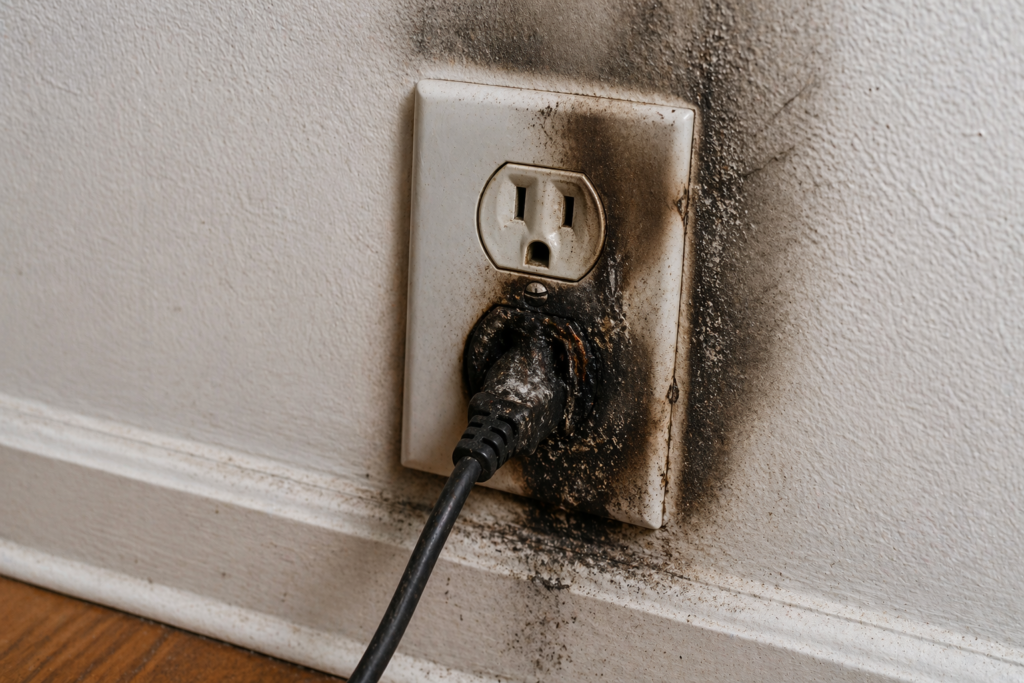
•The Emergency: A loose wire creates high resistance. High resistance creates heat. That heat can melt the plastic housing of the outlet long before a fire ever breaks out.
2. The “Series” Effect: Is Your Whole House at Risk?
Most outlets in your home are wired in a “daisy chain” (series). If one outlet in the middle of the chain fails due to a burnt wire, every outlet “downstream” might lose power too.
•The Risk: The point of failure—the dead outlet—is currently arcing and sparking every time you use a different working outlet on that same circuit.
Is a Dead Outlet Dangerous? Identifying the “Red Flag” Symptoms
Not all dead outlets are created equal. Some are just old, but others are actively trying to tell you that your house is in trouble. Look for these specific signs:
H3: Discoloration and “Char” Marks
Take a close look at the faceplate. Do you see a faint yellow, brown, or black stain around the plug holes? This isn’t dirt. It’s carbon scoring from localized fires happening inside the box.
H3: The “Fishy” Smell
If you walk past a dead outlet and catch a whiff of something that smells like fish or burning electronics, evacuate the area and call a pro. This is the smell of the chemical fire retardants in your insulation beginning to vaporize under extreme heat.
H3: Popping or Sizzling Sounds
If you hear a sound like bacon frying when you stand near the outlet, that is the sound of electricity “jumping” across a gap. This is a textbook Arc Fault, and it is the #1 cause of electrical house fires in the United States.
Common Culprits: Why Do Outlets Actually Die?
To fix the problem, you have to understand the mechanics of the failure. Here are the most common reasons an outlet goes dark in a US household.
1. Tripped GFCI Outlets (The “Ghost” Problem)
In many homes, a single GFCI outlet (the one with the “Test” and “Reset” buttons) protects several other standard outlets downstream. If the GFCI in your bathroom trips, the outlet in your bedroom or hallway might go dead too.
•The Fix: Always check every GFCI in the house—even the ones in the garage or basement—before assuming the wiring is bad.
2. Burnt Terminals and Wire Fatigue
Copper wiring is durable, but it isn’t invincible. Constant vibration from appliances or the natural expansion and contraction of wires as they heat up and cool down can cause the metal to fatigue. Eventually, the wire snaps or the terminal on the outlet burns out.
3. Loose Wire Nuts in Junction Boxes
Sometimes the problem isn’t at the outlet itself, but in a junction box hidden in the attic or crawlspace. A loose wire nut can cause a circuit to “open,” killing power to everything connected to it.
The DIY “Safe Check” vs. When to Call an Electrician
We know Americans love a good DIY project, but electricity doesn’t give second chances. Here is how to safely investigate a dead outlet without putting yourself in the hospital.
Step 1: Use a Non-Contact Voltage Tester
Never stick a screwdriver into an outlet. Buy a $20 non-contact voltage tester. If it glows red when you put it near the dead outlet, there is still “hot” power inside the box, even if the outlet isn’t working. This is a major fire hazard.
Step 2: Check the Breaker Panel (The Right Way)
Sometimes a breaker looks like it’s “ON” but it’s actually tripped. Flip it all the way to “OFF” and then back to “ON” to be sure.
Step 3: Know Your Limits
If you see melted plastic, smell smoke, or if the breaker trips again immediately after you reset it, STOP. You have a serious fault that requires a licensed electrician with a thermal imaging camera to locate.
How to Replace a Dead Outlet Safely (The NEC Way)
If you’ve determined the outlet is simply worn out and you’re comfortable with basic electrical work, here is the professional way to replace it according to the National Electrical Code (NEC).
1. Kill the Power and Verify
Turn off the breaker and use your voltage tester to confirm the box is dead.
2. Use Side-Wire Terminals (No Back-Stabbing!)
When installing the new outlet, wrap the wires clockwise around the screw terminals. This creates a much stronger, safer connection than the push-in slots.
3. Upgrade to Tamper-Resistant (TR) Outlets
The NEC now requires Tamper-Resistant outlets in most residential areas. These have internal shutters that prevent children from sticking objects into the slots.
Preventing Future Failures: Upgrading to Pro-Grade Outlets
Not all outlets are built the same. The “10-cent” outlets sold in bulk at big-box stores are prone to failure.
•Recommendation: Spend the extra $2 per outlet for Commercial Grade or Spec Grade outlets. They have thicker metal contacts and better heat dissipation, making them much less likely to “die” and become a fire hazard.
Conclusion: Don’t Ignore the Warning Signs
A dead outlet is your home’s way of telling you that something is wrong. Whether it’s a simple tripped GFCI or a dangerous loose connection arcing inside your walls, ignoring it is a gamble you shouldn’t take.
Take the time to investigate, use the right tools, and never hesitate to call in a professional when things look suspicious. Your home is your biggest investment—don’t let a $2 outlet be the reason you lose it.
SEO Metadata for this Article:
•Primary Keyword: Is a dead outlet dangerous
•Secondary Keywords: dead outlet fire hazard, why did my outlet stop working, how to fix a dead outlet, electrical safety US homes.
•Target Audience: US Homeowners, DIY enthusiasts, property managers.
•Tone: Authoritative, Urgent, Educational.