
If you’ve ever looked inside an electrical outlet, a light switch box, or your breaker panel and felt completely lost staring at a tangle of black, white, and bare copper wires — you’re not alone. Most homeowners never think twice about what’s happening inside their walls until something goes wrong. And when something does go wrong, understanding even the basics of how your home’s electrical system works can save you time, money, and a whole lot of frustration.What Does the Neutral Wire Do? Understanding the Basics of Electrical Wiring
One of the most misunderstood parts of a home’s wiring is the neutral wire. People hear “hot wire” and they get it — it’s the dangerous one, the one carrying the current. They hear “ground wire” and they think okay, that’s the safety wire. But the neutral? That’s where people start scratching their heads. What does the neutral wire do exactly? Why does it even exist? What happens if it’s loose, broken, or missing?
I’ve been working as an electrician in the United States for over 22 years. I’ve rewired old farmhouses in Vermont, pulled wire in new construction subdivisions in Texas, and troubleshot some of the most bizarre electrical problems you can imagine. In all that time, one thing has stayed consistent — most people don’t understand what the neutral wire does, and that lack of understanding leads to real problems. So let me break it down for you in plain English, the way I’d explain it to a homeowner standing in their kitchen while I’m working on their panel.
The Very First Thing You Need to Know About Home Electrical Wiring
Before we can talk about what the neutral wire does specifically, you need to understand the basic concept of how electricity flows in a home. Think of electricity like water moving through a pipe. For water to flow, it needs a path to go out and a path to come back. Electricity is no different.
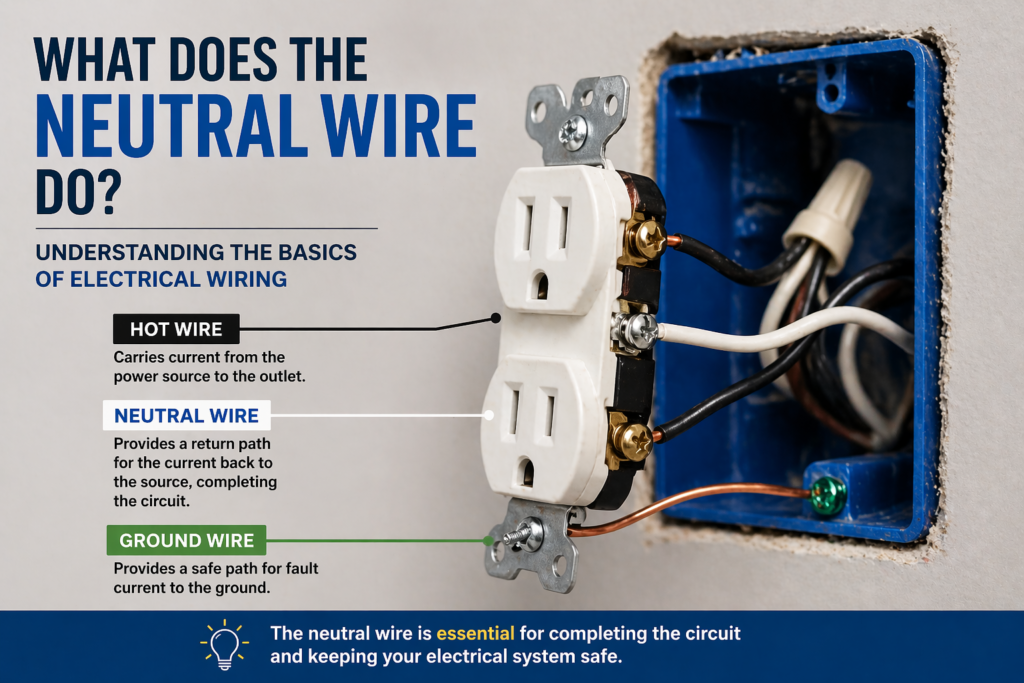
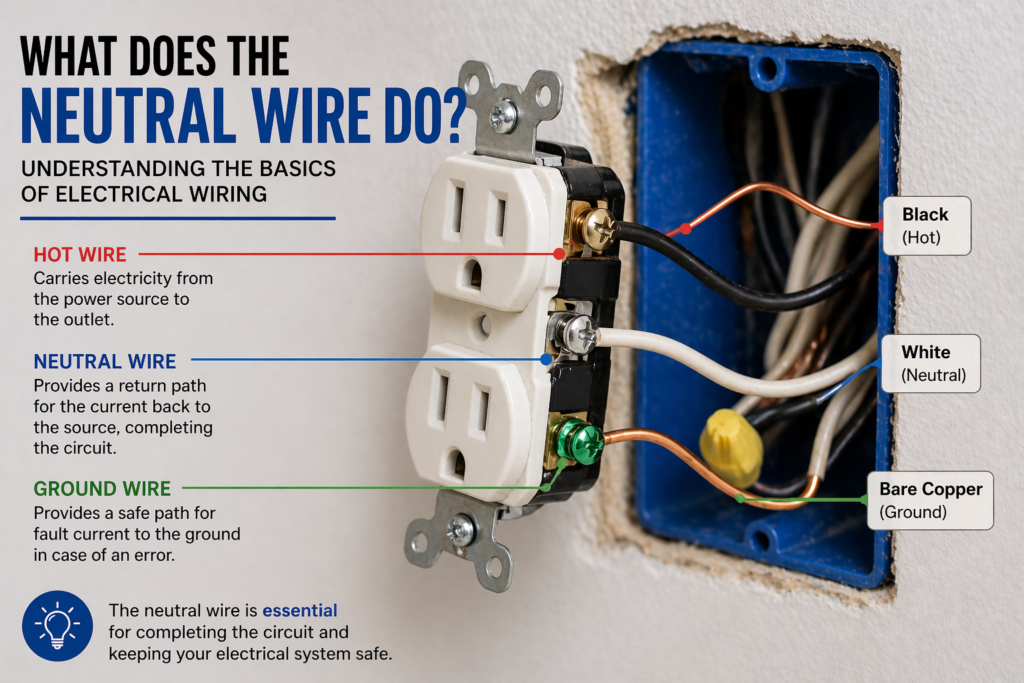
In a standard residential electrical circuit in the United States, you have three wires doing three different jobs:
- The hot wire (usually black, sometimes red) carries electrical current FROM the panel to the device or outlet
- The neutral wire (always white or gray) carries the current BACK to the panel after it’s done its job
- The ground wire (bare copper or green) is a safety wire that only carries current during a fault condition
That’s the core of it. The hot wire brings power to your devices. The neutral wire completes the circuit by bringing that power back. Without both of those wires working properly, current simply cannot flow, and nothing works.
Now, some people read that and think — okay, so the neutral is just the return path. Why does it even need its own wire? Why can’t current just “disappear” after it powers a device?
Great question. The answer is physics. Electrons don’t get “used up” when they power something. They pass through the device, lose energy in the process (which is what powers your light bulb or your microwave), and then they need a return path back to the source. The neutral wire provides that return path.
What Does the Neutral Wire Do in a Standard Circuit?
Let me walk through a simple, real-world example. Picture a basic lamp plugged into a wall outlet. When you flip the switch on that lamp:
- Electrons travel from your electrical panel through the hot wire, through the outlet, through the cord, and into the lamp’s bulb
- Inside the bulb, those electrons push through a resistive element (the filament in older bulbs, or the LED driver in newer ones) — that resistance is what converts electrical energy into light and heat
- After passing through the bulb, the electrons travel back through the neutral wire in the cord, back through the outlet, and all the way back to your panel
That return trip is what the neutral wire does. It completes the loop. Electricians call this a “closed circuit” — the electricity travels in a loop from panel to device and back to panel. If that loop is broken anywhere, the circuit is “open” and nothing works.
The neutral wire in your walls is doing this job constantly, for every single device in your home that’s running at any given moment.
Why the Neutral Wire Is Called “Neutral”
Here’s something that surprises a lot of people. The term “neutral” doesn’t mean the wire is harmless or inactive. It means something very specific in electrical terms — it means the wire is at or near zero volts relative to ground.
In the United States, our standard household voltage is 120 volts. That 120 volts is the difference in electrical potential between the hot wire and the neutral wire. The hot wire sits at 120 volts above the neutral, which is at approximately 0 volts. So when you measure voltage in an outlet with a multimeter, you’re measuring the difference between those two wires.
This is important to understand because many people assume that if the neutral wire is at zero volts, it must be safe to touch. That’s not always true. Under certain fault conditions — like a loose neutral connection somewhere in the circuit — the neutral wire can carry dangerous voltage. I’ve seen people get shocked touching neutral wires because they assumed it was harmless. Don’t make that assumption.
The reason the neutral wire stays close to zero volts under normal conditions is because it’s bonded to the ground at your main electrical panel — specifically at what we call the “main bonding jumper” — and that ground connection is physically tied to the earth through ground rods buried outside your home. That earth connection is what keeps the neutral at zero volts. But more on that relationship between neutral and ground in a bit.
The Neutral Wire and How Your Panel Manages It
Your electrical panel — whether it’s a 100-amp, 150-amp, or 200-amp service — has two sides to it. The hot wires from the utility company feed into your panel, and those hot conductors connect to the breakers. Every breaker in your panel controls one hot wire going out to a circuit.
But every one of those circuits also has a neutral wire coming back. All those neutral wires don’t connect to breakers — they connect to what’s called a “neutral bus bar.” This is a metal bar running along the side or center of your panel where all your neutral wires get screwed down. From there, the neutral bus bar is bonded to the ground bus bar (in your main panel only), and the whole assembly is grounded to the earth.
This is where a lot of confusion happens, especially in older homes with subpanels. In a main panel, the neutral and ground bus bars are bonded together. But in a subpanel, they must be kept separate — isolated from each other. If you bond them together in a subpanel, you create what’s called a “bootleg ground” situation that can be genuinely dangerous and will fail an electrical inspection every single time.
I’ve gone into homes where a previous owner — or worse, a “handyman” — had wired a subpanel wrong, bonding neutral and ground together. It’s one of those things that might not cause obvious problems for years, but it creates conditions where equipment can malfunction unexpectedly, and it can introduce shock hazards that are hard to trace without a meter.
What Does the Neutral Wire Do in 240-Volt Circuits?
This is where things get a little more interesting, and where the neutral wire behaves differently depending on the load.
In a 240-volt circuit — the kind that powers your electric dryer, your electric range, your central air conditioner, or your water heater — you have two hot wires instead of one. These two hot wires are 180 degrees out of phase with each other, which means they push and pull in opposite directions. When measured against each other, they produce 240 volts. When measured against neutral, each one produces 120 volts.
Now, here’s where it gets interesting. A purely 240-volt load — like a well pump or an older style electric water heater — only uses the two hot wires. It doesn’t use a neutral wire at all. The two hot wires balance each other out perfectly, so no current needs to return through a neutral. These circuits only have two hots and a ground.
But a 240/120-volt combination load — like a kitchen range or an electric dryer — has both 240-volt elements AND 120-volt components (like the clock, light, or control board on a range, or the motor and controls on a dryer). Those 120-volt components need a neutral to complete their circuits.
So the neutral wire in a 240/120 circuit carries only the unbalanced portion of the current. If you’re running equal amounts of 120-volt load on both sides of the circuit, the neutral current is zero. If there’s any imbalance — more load on one side than the other — the neutral carries the difference.
This concept is called “unbalanced current” and it matters a lot when you’re sizing wire for circuits and when you’re troubleshooting problems in 240-volt circuits.
What Happens When the Neutral Wire Fails?
This is probably the most important section of this article for homeowners, because a failing neutral wire is one of the most dangerous electrical problems that can happen in a home — and it’s also one of the most misdiagnosed.
Loose Neutral in an Outlet or Junction Box
The most common neutral failure I see is a loose connection. Over time, the screw terminals in outlets, switches, and junction boxes can loosen due to thermal expansion and contraction — the wire heats up slightly when current flows through it, then cools down, and over many cycles, the screw backs off just a hair.
A loose neutral creates resistance at the connection point. That resistance generates heat. I’ve pulled apart outlets and junction boxes where the insulation on the neutral wire was completely melted and blackened because of a loose connection that had been arcing for months. That’s a house fire waiting to happen.
The symptom of a loose neutral in one outlet is pretty straightforward — the outlet doesn’t work, or works intermittently. You might notice lights flickering at that outlet, or devices acting strangely. That’s the circuit telling you something’s wrong.
Open Neutral in a 120-Volt Circuit
If the neutral wire is completely broken (electricians call this an “open neutral”), the circuit simply stops working. No current can flow without a return path. So an open neutral in a standard 120-volt circuit will just make that circuit go dead. It’s annoying and needs to be fixed, but it’s not usually dangerous in a straightforward 120-volt circuit.
Open Neutral in a 240/120 Circuit — This Is the Dangerous One
Now here’s the scenario that can actually hurt people, damage equipment, and in extreme cases, start fires.
If the neutral wire opens in a 240/120-volt circuit — or worse, if the neutral wire feeding an entire section of your home loses its connection at the panel — you end up with what electricians call a “lost neutral” or “floating neutral.”
When this happens, the two legs of your 120-volt service are no longer balanced by the neutral. Instead, the loads on both legs of the circuit start acting like a voltage divider. Heavy loads (appliances with lots of resistance) see lower voltage, while light loads (like a lamp with a LED bulb) see higher voltage — potentially much higher.
I’ve been called to homes where a lost neutral at the utility transformer caused some rooms to have 70 volts while other rooms had 170 volts or more. The low-voltage rooms had appliances that wouldn’t run. The high-voltage rooms had TVs and computers that were literally burning up. One homeowner lost a refrigerator, a TV, and a gaming console in a single afternoon before they figured out what was happening.
If you ever notice some lights getting extremely bright while others dim down, or if your appliances start acting erratically all at once, that’s a red flag for a lost neutral. Turn off your main breaker and call an electrician immediately. This is not a wait-and-see situation.
How to Identify the Neutral Wire
For most homeowners, identifying wires is important when doing basic tasks like replacing an outlet or a light switch. Here’s how the neutral wire is identified in the United States:
Color coding:
- Neutral wires in cables (like Romex) are always white or gray
- In conduit systems, neutral conductors are also white or gray
- Never use a white wire as a hot conductor without marking it with black tape at both ends — this is code requirement
In outlets:
- The neutral connects to the larger slot of the outlet (the left slot when looking at it straight on)
- The neutral connects to the silver screw on the outlet body
- The hot connects to the smaller slot and the gold/brass screw
- The ground connects to the round hole and the green screw
In light fixtures:
- The white wire connects to the silver-colored terminal on the fixture
- The black connects to the gold-colored terminal
This color coding is standardized across the United States by the National Electrical Code (NEC), which is adopted in some form by every state in the country. Some states have amendments, but the basic color coding is universal.
The Neutral Wire vs. the Ground Wire — They Are NOT the Same Thing
I cannot tell you how many times I’ve walked into a situation where someone had tied the neutral and ground wires together somewhere they shouldn’t have. I get it — both wires are ultimately connected to earth ground, both of them end up at a zero-volt potential under normal conditions, and in older wiring systems they were sometimes the same wire. But they serve very different functions, and treating them as interchangeable is a serious mistake.
Here’s the core difference:
The neutral wire carries current under normal operating conditions. Every time you turn on a light, run the microwave, or charge your phone, current is flowing through the neutral wire. It’s an active conductor doing real work on every circuit in your home.
The ground wire carries current ONLY during a fault. Under normal conditions, the ground wire has zero current flowing through it. It’s there as a safety backup — if a hot wire contacts the metal case of an appliance, the ground wire provides a low-resistance path back to the panel, which trips the breaker and prevents you from getting shocked when you touch the appliance.
This distinction matters for several reasons:
- Equipment performance: Many sensitive electronic devices use the neutral and ground as a reference for shielding and noise filtering. If you mix them up, you can introduce ground loops that cause equipment to behave erratically.
- Safety: If you use the ground wire as a neutral (carrying current), that current can flow back through the ground wire into the metal chassis of other appliances. Someone touching those appliances could be energized even when the device seems to be off.
- Code compliance: The NEC is very specific about when and where neutral and ground can be bonded. Mess this up and you’ll fail inspection — or worse, create a hazard that an inspection never catches.
In a main panel, bonding neutral to ground is correct and required. In a subpanel, keeping them separate is correct and required. In an outlet box, they should never be bonded together. Period.
Why Some Switches and Dimmers Need a Neutral Wire
This is something that’s come up a lot in the last 10-15 years as smart home technology has taken off. Homeowners buy a smart dimmer switch — the kind you control with your phone or your voice — and they get home to install it only to discover their switch box doesn’t have a neutral wire. Now what?
Older-style light switches are extremely simple devices. They just interrupt the hot wire. Power comes in on the hot, the switch either connects or disconnects it, and power goes out to the light. The neutral goes directly from the light fixture back to the panel without passing through the switch box at all.
This works fine for a mechanical switch because when the switch is off, there’s literally nothing happening in the switch. No current flows. But smart switches are different — they have a radio receiver, a processor, a WiFi or Z-Wave chip, and they need a small amount of power constantly to “listen” for commands. They need to be powered even when the light is “off.”
To do that, they need a complete circuit — a hot wire AND a neutral wire. Old switch boxes often only have the hot wire (and sometimes a ground). No neutral.
Solutions to this problem include:
- Running a new cable with a neutral to the switch box (the right way, but expensive)
- Using a “no-neutral” smart switch that tricks the circuit by running a tiny trickle of current through the light bulb even when “off” (works with some bulbs, causes buzzing or flickering with others)
- Using a smart switch that communicates via Z-Wave or Zigbee and can use a remote module at the light fixture where the neutral IS present
Understanding what does the neutral wire do in this context is key to solving smart home wiring problems. It’s not just semantics — it has real practical implications for what products will work in your home.
Reading Neutral Wire Basics in Older Homes
If you live in a home built before 1960 or so, your electrical system might have some quirks that make understanding the neutral wire even more important.
Knob-and-tube wiring (pre-1940s): This old wiring system runs the hot and neutral as two completely separate wires, supported by ceramic knobs and running through ceramic tubes where they pass through wood framing. The hot is typically black and the neutral is white, but the insulation is cloth-covered and extremely brittle by now. If you have knob-and-tube wiring, the neutral wire basics still apply — white is neutral, black is hot — but the system has no ground wire at all, and the wiring is at serious end-of-life and should be replaced.
Two-wire Romex (1940s-1960s): This generation of wiring uses modern-style cable but only has two conductors — black (hot) and white (neutral). No ground wire. Many homes built during this era still have this wiring throughout, and it’s legal to leave it in place as long as you’re not extending circuits. If you want to add GFCI protection to these circuits (which I strongly recommend), you need GFCI outlets or breakers.
Aluminum wiring (1965-1973): During this period, copper prices spiked and aluminum wiring became common in residential construction. Aluminum expands and contracts more than copper, which causes connections to loosen over time. Loose connections on neutral wires (or any wires) mean resistance, heat, and fire risk. If you have aluminum wiring, every connection point needs to be inspected and treated with anti-oxidant compound.
What Does the Neutral Wire Do in GFCI Protection?
Ground Fault Circuit Interrupter outlets and breakers — the ones with the TEST and RESET buttons — monitor the relationship between the hot wire and the neutral wire in a very clever way.
Here’s how it works: Under normal conditions, the amount of current flowing out on the hot wire should be exactly equal to the amount of current returning on the neutral wire. Every electron that leaves should come back. If there’s any difference — even a very small one, like 5 milliamps — that means current is leaking somewhere it shouldn’t be.
That “somewhere” might be through your body if you’re getting shocked. Current is finding a path to ground through you rather than returning through the neutral wire. The GFCI detects this imbalance almost instantly — in about 1/40th of a second — and trips the circuit before that current can do serious damage to your heart.
This is why the neutral wire connection to a GFCI device matters so much. If the neutral isn’t connected properly, the GFCI can’t monitor the circuit correctly, and it won’t protect you. I’ve tested GFCI outlets where a previous installer had connected the neutral to the wrong terminal, and the outlet still appeared to work — lights lit up, devices ran — but the GFCI protection wasn’t functioning. That’s a dangerous situation.
Always test your GFCI outlets with the TEST button monthly, and if you’re ever replacing one, make sure the white neutral wire lands on the silver terminal and the LINE and LOAD sides are connected correctly.
Common Neutral Wire Problems I See in the Field
After 22 years of doing this work, I’ve seen just about every neutral wire problem that exists. Here are the ones I come across most often:
1. Neutral wires not fully seated under screw terminals This happens when an installer didn’t strip enough insulation, or they stripped too much and folded the wire back under itself. Either way, poor contact under a screw creates resistance, and resistance creates heat.
2. Multiple neutral wires under a single screw This used to be common in older work and it’s still done by people who don’t know better. One screw should hold one wire. If you double up, one wire can come loose while appearing to be secured by the other. Many modern code editions specifically prohibit double-tapping neutral wires on bus bars.
3. Neutral wires reversed with grounds White wire on the ground terminal, bare copper on the neutral terminal. Both are ultimately at the same potential in a properly bonded system, so you might not notice immediately — but the ground wire isn’t rated to carry load current, and this creates all kinds of code and safety problems.
4. Damaged neutral insulation from staples or mechanical damage Cable staples driven too hard can nick the insulation on the neutral wire. Over time, the wire can arc to the staple. I’ve found more than a few burn marks inside walls from this exact scenario.
5. Loose neutral at the panel bus bar This is probably the number one cause of intermittent circuit problems that drive homeowners crazy. The circuit works sometimes, doesn’t work other times, and nobody can figure out why. Pull the cover on the panel (or have an electrician do it), check every neutral wire for tightness, and you’ll often find one that spins freely because the screw was never torqued properly.
6. Corroded neutral connections In humid environments, or in homes with older panels, neutral connections can oxidize. Corrosion increases resistance, resistance increases heat, and you have a recipe for a serious problem.
When to Call a Professional — Don’t Mess Around With This
I’m all for homeowners understanding their electrical systems. Knowledge is power, pun intended. But understanding what the neutral wire does and actually working on your electrical system are two different things.
Here are situations where you need to call a licensed electrician — not watch a YouTube video and grab your screwdriver:
- Any work inside the main electrical panel
- Chasing an open or lost neutral that you can’t locate
- Any signs of burning, melted insulation, or char marks on wiring
- Flickering lights throughout the house (possible lost neutral from the utility)
- Replacing wiring in older homes with knob-and-tube or aluminum wiring
- Adding new circuits or extending existing ones
- Any work on 240-volt circuits for large appliances
Electrical work is one of those areas where the difference between a knowledgeable amateur and a trained professional can literally be the difference between a house standing and a house burning down. I’ve seen the aftermath of DIY electrical work gone wrong, and it’s not pretty.
What Does the Neutral Wire Do During a Power Surge?
Power surges — sudden spikes in voltage — can travel through your home’s electrical system in ways that most people don’t think about. And the neutral wire is very much involved.
When a surge enters your home (from a lightning strike nearby, from a utility switching event, or from large motors starting up), it travels through both the hot and neutral conductors. Whole-house surge protectors work by detecting this voltage spike and diverting the excess energy to ground before it can reach your appliances.
The neutral wire’s connection to ground is part of what makes this diversion possible. The surge protector essentially shunts the excess voltage between the hot conductor and the ground/neutral, clamping the voltage at a safe level.
This is also why the neutral wire must be properly connected and properly grounded throughout the system for surge protection to work effectively. A loose or corroded neutral connection upstream of a surge protector can reduce the protector’s ability to do its job.
Neutral Wire Basics for New Construction vs. Older Homes
If you’re building a new home or doing a major renovation, you have a huge advantage over people working in older homes — everything is fresh, accessible, and can be done right from the start.
In new construction, modern building codes require:
- All cable to be secured within 12 inches of every box
- Proper wire gauges for every circuit (14 gauge for 15-amp circuits, 12 gauge for 20-amp circuits)
- Neutral wires properly landed on neutral terminals, not doubled up
- Neutral-ground bonding only at the main panel
- Arc-fault circuit interrupter (AFCI) protection on most circuits
- GFCI protection in kitchens, bathrooms, garages, basements, and outdoor locations
In older homes, the goal is usually to bring the existing wiring up to modern standards as much as practical, focus on safety-critical upgrades first (GFCI protection especially), and replace or repair any wiring that’s showing signs of deterioration.
The Bottom Line on What the Neutral Wire Does
After everything we’ve covered, let me bring it back to basics one more time.
The neutral wire completes the circuit. It provides the return path for current to flow back from your devices to the electrical panel after that current has done its job powering your lights, appliances, and electronics. Without the neutral, electricity has nowhere to go and nothing works.
But beyond that simple function, the neutral wire is also deeply tied to the safety of your entire electrical system. It’s connected to ground at your main panel, which keeps it at zero volts and gives your protection devices something to reference. It’s monitored by GFCI outlets and breakers to detect ground faults. It’s the key to how your smart home devices and two-pole appliances function.
Understanding what the neutral wire does gives you a foundation for understanding how your home’s electrical system works as a whole. And that understanding helps you recognize when something’s wrong — when to take action, when to call a professional, and when to stay well away from something that’s above your skill level.
Electricity is one of the most useful and most dangerous things in your home. Respect it, understand it, and don’t hesitate to bring in someone who does this for a living when the situation calls for it.
Quick Reference: Neutral Wire Facts for Homeowners
- Always white or gray in U.S. residential wiring
- Connects to the silver screw on outlets, silver terminal on fixtures
- Connects to the larger (left) slot of a standard outlet
- Carries current back to the panel under normal operating conditions
- Must NOT be bonded to ground anywhere except the main panel
- Can be dangerous to touch — don’t assume it’s safe just because it’s “neutral”
- Loose or broken neutrals are a fire and safety hazard
- Required for smart switches, GFCI monitoring, and combination 120/240-volt appliances
- If you suspect a problem with your neutral wiring, call a licensed electrician
This article reflects the knowledge and experience of a working licensed electrician in the United States. Electrical codes vary by jurisdiction. Always check your local codes and permit requirements before doing any electrical work, and consult a licensed professional for anything beyond basic maintenance.