
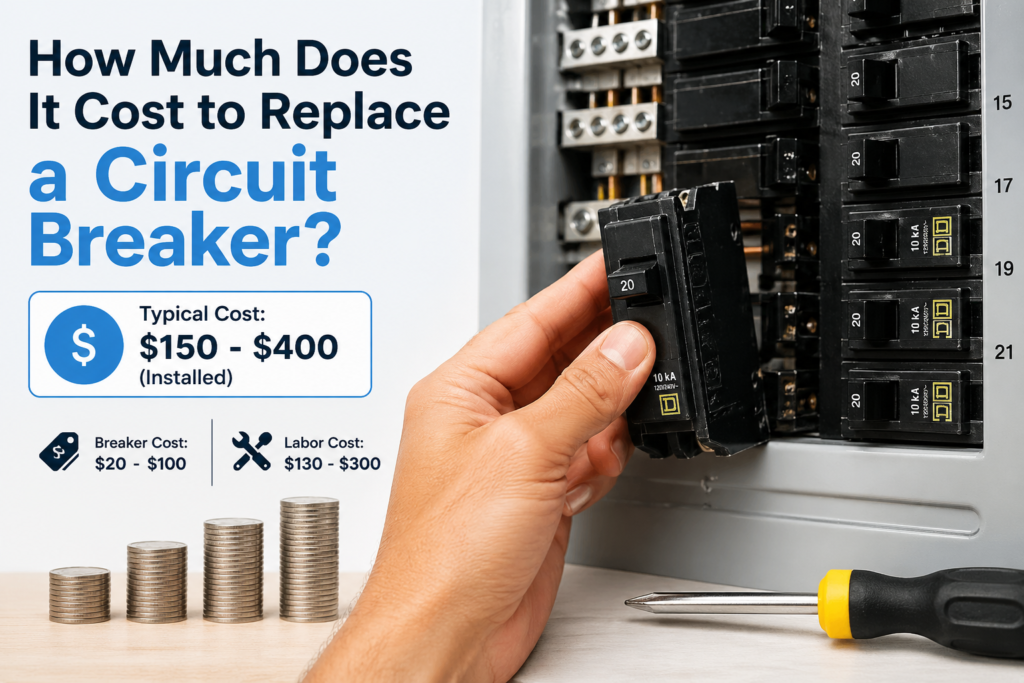
how much does it cost to replace a circuit breaker? Our 2026 guide breaks down prices from $100 to $600+ for homeowners across the USA. Get real costs, factors, and tips.
What Is a Circuit Breaker and Why Replace It?
A circuit breaker is the safety switch inside your electrical panel that protects your home from electrical fires. When too much current flows through a wire, the breaker trips and cuts power. Over time, breakers wear out, corrode, or fail to trip when they should.
If you’re asking how much does it cost to replace a circuit breaker, the answer depends on what exactly needs replacing. Are you swapping one switch inside the panel? Replacing the main breaker? Or upgrading the entire panel? Each scenario has a different price tag.
Types of Circuit Breaker Replacement
| Replacement Type | Typical Cost Range | Time Required |
|---|---|---|
| Single circuit breaker | $100 – $375 | 30 min – 1 hour |
| Main breaker | $200 – $600 | 1 – 2 hours |
| Full panel replacement | $1,200 – $4,000 | 4 – 8 hours |
| Service upgrade (100A to 200A) | $1,500 – $4,500 | 6 – 12 hours |
Understanding these differences is the first step to answering how much does it cost to replace a circuit breaker for your specific situation .
How Much Does It Cost to Replace a Circuit Breaker? The Short Answer
For most American homeowners in 2026, how much does it cost to replace a circuit breaker falls between $100 and $375 for a standard single-pole breaker replacement . This includes the breaker unit ($10–$30) plus electrician labor and service fees ($90–$250) .
However, costs vary significantly based on breaker type, location, and job complexity. A GFCI breaker runs $220–$340 installed, while a main breaker replacement costs $200–$600 . Full panel replacements start around $1,200 and can exceed $4,000 for complex upgrades .
Breaker Types and Their Costs
Not all breakers cost the same. The type you need directly impacts how much does it cost to replace a circuit breaker.
Standard Single-Pole Breakers ($100–$300 Installed)
These protect standard 120V circuits for lights and outlets. The breaker itself costs $10–$30, making this the most affordable replacement option .
AFCI Breakers ($165–$290 Installed)
Arc Fault Circuit Interrupters detect dangerous electrical arcing that causes fires. Required by modern code in most jurisdictions, these cost $30–$100 for the unit alone .
GFCI Breakers ($220–$340 Installed)
Ground Fault Circuit Interrupters protect against electrocution near water sources. Required for kitchens, bathrooms, garages, and outdoor circuits .
Double-Pole Breakers ($180–$600 Installed)
These handle 240V circuits for large appliances like dryers, ranges, and HVAC units. Higher amperage means higher cost .
Main Breakers ($200–$600 Installed)
The master switch controlling your entire home’s power. Replacement requires utility coordination and carries higher risk .
| Breaker Type | Unit Cost | Installed Cost |
|---|---|---|
| Standard single-pole | $10–$30 | $100–$300 |
| AFCI | $30–$100 | $165–$290 |
| GFCI | $40–$100 | $220–$340 |
| Double-pole | $30–$100+ | $180–$600 |
| Main breaker | $50–$200 | $200–$600 |
Labor Costs: Where Your Money Goes
When calculating how much does it cost to replace a circuit breaker, labor typically represents 60–70% of the total bill .
Electrician Hourly Rates
Licensed electricians charge $50–$150 per hour depending on location and experience . Coastal cities and major metros command premium rates, while rural areas often fall on the lower end.
Minimum Service Fees
Most electricians charge a minimum service call fee of $50–$200, even for 20-minute jobs . This covers travel, diagnostics, and overhead.
Emergency Rates
After-hours, weekend, or holiday service costs 1.5–2x normal rates . A $200 job becomes $300–$400 if your breaker fails at 10 PM on a Saturday.
Factors That Affect Replacement Cost
Several variables influence how much does it cost to replace a circuit breaker in your specific case:
1. Panel Condition
Old, corroded, or damaged panels require extra care. If the bus bars are burnt or connections are loose, simple breaker replacement becomes more complex .
2. Accessibility
Panels behind finished walls, in cramped closets, or in damp basements take longer to access safely. Difficult access adds $50–$200 to labor costs .
3. Code Compliance Upgrades
Modern NEC code requires AFCI/GFCI protection on most circuits. Upgrading from standard breakers during replacement adds $30–$100 per breaker .
4. Permits and Inspections
Many jurisdictions require permits for electrical work. Fees run $50–$300 and include mandatory inspections .
5. Regional Variations
Labor rates vary dramatically by location:
| Region | Typical Hourly Rate | Panel Replacement Range |
|---|---|---|
| Northeast (NYC, Boston) | $120–$150 | $2,500–$4,000 |
| West Coast (SF, LA) | $100–$140 | $2,000–$3,500 |
| Midwest (Chicago) | $50–$150 | $1,500–$3,000 |
| Southeast (Atlanta) | $60–$100 | $1,200–$2,500 |
| Rural/Small Towns | $50–$80 | $1,000–$2,000 |
Full Panel Replacement vs. Single Breaker
Sometimes how much does it cost to replace a circuit breaker isn’t the right question. If your panel itself is failing, you’re looking at a much bigger project.
When Panel Replacement Is Necessary
- Your panel is 25+ years old
- You have a Federal Pacific or Zinsco panel (fire hazards)
- The panel shows burn marks, rust, or corrosion
- You’re adding major appliances or an EV charger
- Insurance requires an upgrade
- Breakers trip constantly despite no overload
Panel Replacement Costs (2026)
| Project | Cost Range |
|---|---|
| Basic panel swap (same size/location) | $1,200–$2,500 |
| 100A to 200A upgrade | $2,000–$4,000 |
| Fuse box to breaker conversion | $1,500–$4,500 |
| Panel relocation | $3,000–$6,000 |
| Federal Pacific/Zinsco replacement | $1,500–$4,000 |
A standard 200-amp panel costs $250–$350 for the box alone, plus $100–$400 for breakers, $200–$500 for wiring, and $1,000–$2,500 for labor .
Hidden Costs to Watch For
Budgeting for how much does it cost to replace a circuit breaker? Watch for these surprise expenses:
Wiring Repairs ($200–$4,500)
Old or damaged wiring behind the panel may need replacement. Aluminum wiring, knob-and-tube, or ungrounded systems require updates .
Drywall Repair ($1.50–$3/sq ft)
Accessing panels often requires cutting into walls. Patching and painting adds to the total .
Grounding Upgrades ($100–$500)
Modern code requires proper grounding. Older homes often lack adequate ground rods and bonding .
Utility Coordination Delays
Service upgrades require utility disconnection/reconnection. While usually free, scheduling delays can extend project timelines .
DIY vs. Professional: Should You Do It Yourself?
The breaker costs $10–$30 at the hardware store. So why pay $200+ for professional installation?
Risks of DIY Breaker Replacement
- Electrocution: Service lugs remain live even with the main breaker off
- Fire hazards: Improper installation causes overheating
- Code violations: Unpermitted work voids insurance
- Misdiagnosis: The breaker may not be the real problem
When DIY Might Work
Only if you have electrical experience, proper tools (insulated screwdrivers, torque screwdriver, voltage tester), and your panel is modern and accessible. Even then, permits may be required .
Bottom line: For most homeowners, hiring a licensed electrician is the safest choice when considering how much does it cost to replace a circuit breaker .
How to Save Money on Breaker Replacement
Get Multiple Quotes
Prices for identical jobs vary by $1,000+ between contractors. Get 3+ quotes and compare itemized breakdowns .
Bundle Electrical Work
Combine breaker replacement with other projects (outlet additions, lighting) to save on service fees.
Avoid Emergency Calls
Schedule during business hours. Wait until Monday rather than paying weekend rates.
Consider Alternatives to Full Upgrades
| Alternative | Cost | Best For |
|---|---|---|
| Circuit sharing device | $400–$900 | EV charger + dryer same circuit |
| Smart breakers | $600–$1,200 | Load management |
| Subpanel addition | $800–$2,000 | Adding circuits, no amperage increase |
| Meter collar | $500–$1,000 | Solar/EV coordination |
These options cost 85–90% less than full service upgrades .
Signs You Need Breaker Replacement
Don’t ignore these warning signs:
- Breaker trips repeatedly
- Burning smell from panel
- Scorch marks or discoloration
- Breaker won’t stay reset
- Buzzing or humming sounds
- Panel feels warm
- Lights flicker or dim
If you notice any of these, how much does it cost to replace a circuit breaker becomes less important than doing it immediately for safety .
FAQ: How Much Does It Cost to Replace a Circuit Breaker?
Q: What is the average cost to replace a circuit breaker?
A: $100–$375 for a standard single-pole breaker, including parts and labor .
Q: Why do electricians charge so much for a $15 part?
A: You’re paying for expertise, insurance, tools, travel, diagnostics, and safety guarantees—not just the breaker .
Q: Does location affect how much does it cost to replace a circuit breaker?
A: Yes. Urban areas with higher living costs see rates 40–60% above rural markets .
Q: Can I replace a breaker myself to save money?
A: Technically yes, but the risks of electrocution, fire, and code violations make professional installation strongly recommended .
Q: How long does breaker replacement take?
A: 30 minutes to 2 hours for standard jobs. Panel replacements take 4–8 hours .
Q: Do I need a permit to replace a circuit breaker?
A: Many jurisdictions require permits even for single breaker replacements. Check with your local building department .
Conclusion: Budgeting for Your Breaker Replacement
So how much does it cost to replace a circuit breaker? For most homeowners, budget $150–$300 for standard replacement. Main breakers run $200–$600. Full panel replacements start at $1,200 and can reach $4,500+ for complex upgrades .
The key is hiring a licensed, insured electrician who pulls permits and stands behind their work. Get multiple quotes, understand what’s included, and don’t ignore warning signs. Your home’s electrical system is too important to gamble with.