
Introduction: When One Room Goes Dark
It always starts the same way. You’re watching TV in the living room, blow-drying your hair in the bathroom, or working on a project in the garage, and suddenly—click. The lights go out. The outlets die. Everything stops. You trudge down to the basement, flip the breaker back on, and hope for the best. Sometimes it holds for hours. Sometimes it trips again in five minutes. And sometimes, it trips the instant you reset it, no matter what you do.
If your circuit breaker keeps tripping in one room, you’re not dealing with a whole-house electrical failure. You’re dealing with something more specific—and often more solvable. One room losing power while the rest of your home hums along normally means the problem is isolated to a single circuit. That circuit might be overloaded, shorted, grounded, or connected to a failing appliance. The breaker itself might be worn out. Or there could be something lurking inside your walls that you can’t see and definitely don’t want to ignore.
This guide is built for American homeowners from coast to coast—whether you’re in a 1920s bungalow in Portland, a 1970s ranch in Atlanta, a new build in Phoenix, or a converted brownstone in Brooklyn. Electrical systems vary by region, climate, and era, but the principles of diagnosis and safety are universal. By the end of this article, you’ll know exactly what’s happening in that one troublesome room, what you can safely fix yourself, and when you need to pick up the phone and call a licensed electrician before something catches fire.
Why One Room? Understanding Your Home’s Electrical Layout
American homes are wired in circuits, not room-by-room. A single circuit breaker in your panel might control the outlets and lights in your bedroom, half your hallway, and the bathroom down the hall. Another breaker might serve only your kitchen countertops. A third might handle your garage and one exterior outlet. The mapping rarely follows floor plans in ways that seem logical to homeowners.
When a circuit breaker keeps tripping in one room, what you’re actually experiencing is one circuit failing—and that circuit just happens to serve that room most noticeably. The bedroom breaker might also control the hallway light you never use, or the outlet behind the dresser where your phone charger sits idle. The garage breaker might also protect the outdoor outlet where you plug in the Christmas lights three weeks a year.
Understanding this matters because the cause of the trip might not be in the room where you notice the outage. The overloaded hair dryer in your bathroom might be sharing a circuit with the bedroom where the lights just went out. The space heater in your living room might be on the same breaker as the dining room chandelier. Diagnosing a single-room trip requires thinking about the entire circuit, not just the space where the lights died
.
The Three Electrical Faults Explained in Plain English
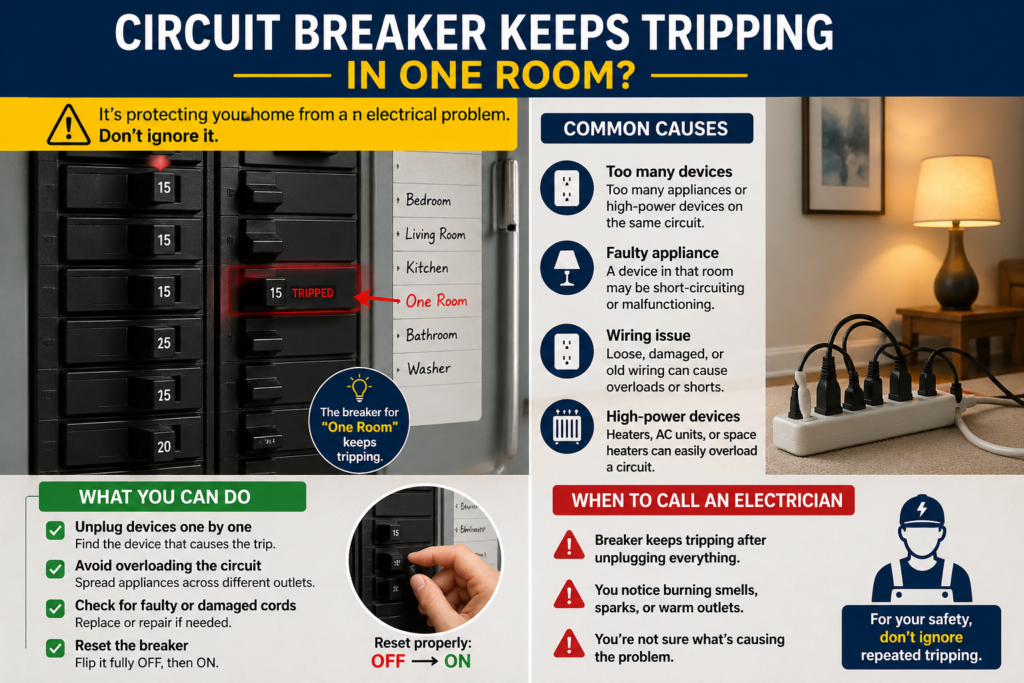
Every circuit breaker trip—whether it’s once a year or every five minutes—happens because the breaker detected one of three dangerous conditions. Understanding these three faults is the foundation of every diagnosis you’ll perform.
Overload: Too Many Things Asking for Power at Once
An overload is the most common and usually the least dangerous cause of a tripped breaker. It happens when the total electrical demand on a circuit exceeds what the wiring can safely carry without overheating.
Think of your electrical circuit like a highway. A 15-amp circuit is a two-lane road. It can handle a steady flow of traffic—your lamp, your phone charger, your laptop—without any problem. But when you add a space heater (12.5 amps), you’ve basically parked a semi-truck across both lanes. The traffic backs up. The road overheats. And the breaker—the traffic cop—shuts the whole thing down before the asphalt melts.
The National Electrical Code specifies that a 15-amp circuit should carry no more than 12 amps continuously (the 80% rule). A 20-amp circuit should carry no more than 16 amps. Exceed these limits, and the breaker trips to prevent the wiring inside your walls from overheating and igniting the surrounding insulation and framing.
Overload trips are usually predictable. They happen when specific combinations of devices run simultaneously. They might only occur in winter when the space heater is running, or in summer when the window AC unit kicks on. If you unplug everything, reset the breaker, and it stays on until you plug certain things back in, you’ve found an overload.
Short Circuit: When Wires Touch Where They Shouldn’t
A short circuit is far more serious. It occurs when the hot wire (the one carrying electricity into your devices) comes into direct contact with the neutral wire (the one carrying it back to the panel). This creates a path of virtually zero resistance, causing an enormous surge of current—often hundreds of amps—that the breaker detects instantly.
Short circuits produce violent, immediate trips. The breaker snaps open with an audible pop or flash. The problem could be inside an appliance, within an outlet, inside a light fixture, or in the walls themselves. Common causes include damaged cords, wires pinched by nails or screws, rodents chewing through insulation, water infiltration into electrical boxes, and loose connections that have shifted and touched each other.
Unlike overloads, short circuits don’t care what’s plugged in. They’ll trip the breaker even with nothing connected to the circuit, because the fault is in the wiring itself.
Ground Fault: When Electricity Escapes Its Path
A ground fault occurs when electricity strays outside its intended path and flows to the ground—often through water, a person’s body, or the metal frame of an appliance. Ground Fault Circuit Interrupters (GFCIs) detect even tiny amounts of stray current (as little as 4 to 6 milliamps) and trip almost instantly.
Ground faults are particularly dangerous in wet locations. A ground fault in your bathroom could send current through the water on your floor. In your kitchen, it could energize the metal sink you’re touching. In your garage, it could turn a concrete floor into a shock hazard.
If your circuit breaker keeps tripping in one room and that room is a bathroom, kitchen, garage, basement, laundry room, or outdoor area, a ground fault should be at the top of your suspicion list.
Step-by-Step Diagnosis: Finding the Exact Cause
Before you call an electrician, you can perform safe, logical diagnostics that will either solve the problem or give the professional precise information that saves you money on the service call.
Step 1: Map What’s Actually on the Circuit
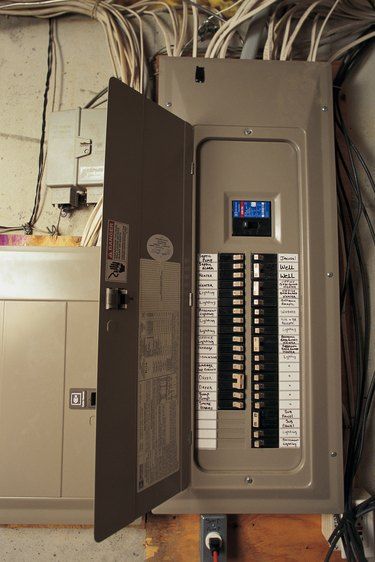
Most homeowners have no idea which breaker controls which outlets. Now is the time to find out. Go to your electrical panel and look at the breaker labels. If they’re accurate, great. If they’re vague (“upstairs,” “bedrooms”) or missing entirely, you’ll need to do some detective work.
Turn the suspect breaker off. Walk through your home with a phone charger or lamp and test every outlet. Note which ones are dead. Check every light switch. Check outdoor outlets. Check the basement and garage. You might discover that the “bedroom” breaker also controls the bathroom down the hall, the hallway light, and the outlet on the porch. This information is crucial because the real culprit might be hiding in one of those connected spaces.
Step 2: Perform a Complete Unplug
Go to every outlet on the affected circuit and unplug every single device. Don’t just turn things off—many electronics draw standby power even when “off.” Physically remove every plug from every outlet. Turn off every light switch. You want the circuit completely unloaded.
Step 3: Reset and Observe
Go to your panel and reset the breaker using the proper technique: push the switch firmly to the “off” position first (you should feel a distinct click), wait ten seconds, then push it firmly to the “on” position.
If the breaker stays on with nothing connected, congratulations—you’ve narrowed it down to an overload or a faulty appliance. Proceed to Step 4.
If the breaker trips immediately with absolutely nothing plugged in and no lights turned on, you have a short circuit, ground fault, or bad breaker. Skip to Step 6.
Step 4: Reconnect Devices One by One
With the breaker holding and everything still unplugged, start reconnecting your devices one at a time. Turn each device on and let it run for at least a minute before adding the next. When the breaker trips, you’ve found your culprit.
Pay special attention to these high-draw appliances that commonly cause single-room overloads:
| Appliance | Typical Wattage | Amps at 120V |
|---|---|---|
| Space heater | 1,500W | 12.5A |
| Hair dryer | 1,800W | 15.0A |
| Microwave | 1,200W | 10.0A |
| Window AC unit | 1,200W | 10.0A |
| Toaster oven | 1,400W | 11.7A |
| Coffee maker | 1,000W | 8.3A |
| Vacuum cleaner | 1,200W | 10.0A |
| Electric blanket | 200W | 1.7A |
| Gaming console | 200W | 1.7A |
| Desktop computer | 300W | 2.5A |
| Television | 200W | 1.7A |
If your 15-amp bedroom circuit has a space heater (12.5A), a TV (1.7A), a laptop charger (1.5A), and a phone charger (0.1A), you’re at 15.8 amps—well over the safe limit. The breaker is doing exactly what it should.
Step 5: Calculate and Redistribute
Add up the amps of everything you want to run simultaneously. If the total exceeds 12 amps on a 15-amp circuit or 16 amps on a 20-amp circuit, you have an overload. Your options are:
- Redistribute: Move high-draw devices to outlets on different circuits
- Upgrade: Have an electrician install a 20-amp circuit if the wiring supports it
- Add a circuit: Run a new dedicated circuit for the problematic appliance
- Use less: Accept that you can’t run the space heater and the hair dryer at the same time
Step 6: Inspect for Visible Damage
If the breaker trips with nothing plugged in, the problem is in the wiring, the outlets, the switches, or the breaker itself. Start with a visual inspection of every outlet and switch on the circuit.
Look for:
- Burn marks, scorching, or discoloration around the slots
- A buzzing or humming sound
- Warmth or heat when you touch the cover plate
- A loose plug that falls out easily
- Visible cracks or damage to the faceplate
- A strange smell, especially burning plastic
If you find any of these signs, do not use that outlet or switch. Turn off the breaker and call an electrician immediately. These are indicators of dangerous arcing or loose connections that can start fires.
Step 7: Check Every GFCI Outlet
Many circuits, especially those in bathrooms, kitchens, garages, and outdoors, are protected by GFCI outlets. A single GFCI can protect multiple standard outlets downstream on the same circuit. If the GFCI trips, every outlet it protects loses power—even though the breaker in the panel appears fine.
Locate every GFCI outlet on the affected circuit. Look for the “TEST” and “RESET” buttons. Press “RESET” firmly. If it pops back out immediately, you have a persistent ground fault. If it holds, the problem may have been a one-time event (water splashing on an outdoor outlet, for example).
Step 8: Test the Breaker Itself
Breakers are mechanical devices that wear out. After years of use—or repeated tripping—the internal contacts, springs, and latches can fail. A worn breaker may trip at loads well below its rated capacity, or it may fail to stay engaged at all.
Signs of a bad breaker include:
- The switch feels loose or floppy compared to others
- The breaker or connected wire is warm
- The breaker buzzes or hums
- Other breakers work fine, but this one consistently fails
- The breaker is very old (20+ years)
If you suspect a bad breaker and have electrical experience, you can test it by moving the circuit wire to an adjacent breaker of the same rating. If the new breaker holds, the original was faulty. If the new breaker also trips, the problem is in the wiring.
Warning: The panel contains live components. Only attempt this if you are qualified.
Room-by-Room Breakdown: Common Causes by Location
Different rooms have different electrical demands, different code requirements, and different common failure modes. Here’s what to look for in each space.
Bedroom
Bedrooms are often on 15-amp circuits shared with hallways and sometimes bathrooms. The most common bedroom overload culprit is the space heater. A 1,500-watt space heater draws 12.5 amps—more than 80% of a 15-amp circuit’s capacity. Add a lamp, a phone charger, and a laptop, and you’ve exceeded the limit.
Electric blankets and heated mattress pads can also cause issues, especially older models with frayed cords or damaged controllers. If your bedroom breaker trips only at night, check your bedding.
Ceiling fans are another common source. A wobbly fan can loosen wire connections over time, and the motor can develop internal shorts. If your breaker trips when you turn on the ceiling fan, the fan itself may be the problem.
Bathroom
Bathrooms are required by modern code to have at least one 20-amp circuit dedicated to outlets, protected by GFCI. Older homes often have bathrooms on shared 15-amp circuits with no GFCI protection—a dangerous combination.
The hair dryer is the bathroom’s most notorious breaker-tripper. A standard hair dryer draws 15 to 18 amps. If your bathroom is on a 15-amp circuit shared with the bedroom down the hall, using the hair dryer while the bedroom TV is on will trip the breaker every time.
Water is the other major bathroom hazard. Splashing from the sink or tub can get into outlets and switches, creating ground faults. Exhaust fans can accumulate moisture and develop electrical problems. If your bathroom breaker trips after showers or baths, moisture is the likely cause.
Kitchen
Kitchens are the most electrically demanding rooms in most homes. Countertop appliances—microwaves, toaster ovens, coffee makers, blenders, air fryers—can easily overwhelm circuits designed decades ago when kitchens had far fewer gadgets.
Modern code requires at least two 20-amp small appliance circuits for kitchen countertops. If your home was built before this requirement and your kitchen has only one circuit, you’ll trip the breaker regularly. The solution is adding circuits, not bigger breakers.
Refrigerators and dishwashers should be on dedicated circuits. If your refrigerator shares a circuit with the microwave, the startup surge from the fridge compressor (which can hit 20+ amps momentarily) will trip the breaker when the microwave is running.
Garbage disposals are another common culprit. A jammed disposal motor draws excessive current. If your kitchen breaker trips only when you run the disposal, check for jams and ensure the disposal is on its own circuit.
Living Room / Family Room
Living rooms often combine entertainment systems, lighting, and sometimes space heaters or window air conditioners. The entertainment center—with its TV, sound system, gaming console, cable box, and streaming devices—can draw surprising power, especially if everything is on a power strip plugged into a single outlet.
Power strips are not circuit breakers. They don’t increase your circuit’s capacity. Plugging a power strip into a 15-amp outlet doesn’t give you 30 amps. It just gives you more places to overload the same 15 amps.
Window air conditioners are the living room’s most common overload source. A medium unit draws 10 to 15 amps continuously, with startup surges significantly higher. If your living room is on a 15-amp circuit, a window AC will likely trip the breaker unless it’s the only thing running.
Garage
Garages are harsh electrical environments. They’re hot in summer, cold in winter, humid, dusty, and often home to power tools that draw massive current. A circular saw can pull 15 amps. A table saw might need 20. A compressor can spike to 30 amps on startup.
Garage outlets are required to be GFCI-protected, which adds another layer of complexity. GFCI outlets in garages can become overly sensitive with age, tripping from normal appliance operation or even from moisture in the air.
Extension cords are the garage’s silent killer. A 100-foot 16-gauge extension cord has significant resistance. Run a 15-amp tool through it, and the voltage drop can cause the motor to overheat and draw even more current, tripping the breaker. Always use heavy-gauge, short extension cords for high-draw tools.
Basement
Basements combine all the challenges of garages with the added hazards of moisture, flooding, and often outdated wiring. If your basement breaker keeps tripping, check for:
- Water in outlets or junction boxes from leaks or flooding
- Dehumidifiers running continuously and overheating
- Sump pumps with failing motors drawing excessive current
- Old wiring that’s been modified by previous homeowners
- Rodents nesting in insulation and chewing wires
Laundry Room
Washing machines and electric dryers are major power consumers. A washing machine can draw 10 amps during the spin cycle. An electric dryer needs a dedicated 240-volt, 30-amp circuit—if it’s on a standard 120-volt circuit, that circuit is dangerously overloaded.
Gas dryers use less electricity but still need a dedicated 120-volt circuit for the drum motor and controls. If your laundry room breaker trips, ensure the washer and dryer are on separate, properly sized circuits.
When the Problem Is the Appliance, Not the Wiring
Sometimes a circuit breaker keeps tripping in one room because a single device has developed an internal fault. These appliance-specific trips can be tricky because the device might work fine for weeks, then suddenly start tripping the breaker every time you turn it on.
Space Heaters
Space heaters are the number one appliance-related breaker tripper in American homes. They draw massive current, their cords can become damaged from being moved around, and cheap models often have inadequate safety features.
If your breaker trips only when the space heater is on:
- Check the cord for damage, kinks, or exposed wires
- Ensure the heater’s wattage doesn’t exceed your circuit’s capacity
- Never use an extension cord or power strip with a space heater
- Consider replacing old or cheap heaters with modern models that have tip-over protection and overheat shutoffs
Window Air Conditioners
Window AC units draw high current continuously, with significant startup surges. As compressors age, they draw more and more current to start, eventually exceeding the breaker’s capacity.
If your AC trips the breaker:
- Clean or replace the filter—restricted airflow makes the compressor work harder
- Check that the unit is properly sized for the circuit
- Consider a dedicated 20-amp circuit if you don’t have one
- If the unit is more than 10 years old, replacement may be more cost-effective than electrical upgrades
Refrigerators and Freezers
Refrigerators cycle on and off, with compressor startup surges that can spike to 3-5 times the running current. As compressors age, these surges get larger. A fridge that never tripped the breaker before might start doing so as the compressor wears out.
If your fridge is tripping the breaker:
- Clean the condenser coils—dust buildup makes the compressor work harder
- Check the door seals—warm air infiltration increases compressor run time
- If the fridge is over 15 years old, the compressor may be failing
Hair Dryers and Curling Irons
These bathroom staples draw enormous current for their size. A 1,800-watt hair dryer pulls 15 amps—exactly the rating of many bathroom circuits. If your bathroom is on a shared circuit, using the hair dryer while anything else is running will trip the breaker.
The only real solution is circuit redistribution or upgrading to a dedicated 20-amp bathroom circuit.
Power Tools
Power tools—drills, saws, sanders, compressors—can draw massive startup current. A compressor motor might pull 30 amps for a fraction of a second when it starts. If your circuit is already near capacity, that surge pushes it over the edge.
Always plug power tools directly into wall outlets, never through extension cords or power strips. If your garage workshop regularly trips breakers, consider having a dedicated 20-amp circuit installed.
Hidden Dangers Inside Your Walls
Not every cause of a circuit breaker keeps tripping in one room is visible or obvious. Some of the most dangerous problems are hiding where you can’t see them.
Aluminum Wiring
If your home was built between 1965 and 1973, it may have aluminum branch circuit wiring. Aluminum expands and contracts more than copper with temperature changes, causing connections to loosen over time. Loose connections create resistance, which generates heat, which can start fires.
Aluminum wiring isn’t inherently dangerous if properly maintained with approved connectors and anti-oxidant paste. But many homeowners and handymen have modified aluminum circuits using standard copper-rated devices, creating hazardous connections. If you suspect aluminum wiring, have a licensed electrician inspect every connection.
Knob-and-Tube Wiring
Homes built before 1950 may have knob-and-tube wiring—a system with no ground wire, designed for much lower electrical loads than modern homes demand. This wiring is a fire hazard when covered with insulation, overloaded with modern appliances, or improperly modified.
Many insurance companies refuse to insure homes with active knob-and-tube wiring. If your older home has persistent breaker issues, complete rewiring may be necessary.
Rodent Damage
Mice, rats, and squirrels chew electrical wiring. They nest in attics, crawl spaces, and wall cavities, gnawing through insulation and exposing conductors. This creates short circuits and fire hazards.
Signs include droppings near electrical boxes, chewed insulation, and intermittent problems that worsen in cold weather. If you suspect rodent damage, call an electrician and an exterminator.
Water Damage
Roof leaks, plumbing failures, flooding, and humidity can introduce moisture into outlets, junction boxes, and panels. Water causes corrosion, creates ground fault paths, and can produce short circuits.
If breaker issues started after a leak or storm, water damage is likely. Never restore power to water-damaged circuits until they’ve been professionally inspected and dried.
Backstabbed Connections
From the 1970s through the 1990s, many outlets were wired using “backstab” connections—wires pushed into holes in the back of the outlet rather than wrapped around side terminal screws. These connections are notoriously unreliable.
The small contact area creates resistance and heat. Spring clamps weaken over time. A backstabbed outlet can work for years, then suddenly fail—taking every downstream outlet with it. If you have outlets from this era, have an electrician inspect and replace backstabbed connections.
DIY Fixes You Can Safely Attempt
Some causes of a circuit breaker keeps tripping in one room are simple enough for a competent homeowner to address.
Redistribute Your Loads
The simplest fix is often the best. Unplug high-draw appliances from overloaded circuits and move them to different outlets on different circuits. Use extension cords only as temporary solutions, and never with space heaters or air conditioners.
Reset GFCI Outlets
Locate every GFCI on the affected circuit and press the “RESET” button firmly. If it holds, the problem may have been a temporary ground fault. If it trips again immediately, you have a persistent fault that needs professional attention.
Replace a Standard Outlet
If you’ve identified a specific outlet as the problem and you’re comfortable with basic wiring:
- Turn off the breaker
- Verify power is off with a non-contact voltage tester
- Remove the old outlet
- Install a new one, connecting wires to the side terminal screws
- Never use backstab connections
Replace a Faulty Breaker
If testing confirms the breaker itself is bad:
- Purchase an identical replacement (same brand, amperage, and type)
- Turn off the main breaker
- Remove the panel cover
- Disconnect the wire from the old breaker
- Remove the old breaker from the bus bar
- Install the new breaker and reconnect the wire
- Replace the cover
Only attempt this if you have electrical experience. The panel contains live components.
When You Must Call a Licensed Electrician
Some problems are too dangerous, too complex, or too code-sensitive for DIY. Call a professional if:
- The breaker trips with nothing plugged in
- You smell burning plastic or see scorch marks
- The panel or any outlet is warm or hot
- You have aluminum or knob-and-tube wiring
- The problem involves the main panel or service entrance
- You need to add new circuits or upgrade panel capacity
- You’re not 100% confident in your abilities
The cost of an electrician’s visit is a small price compared to a house fire or electrocution.
Cost Guide: What American Homeowners Pay for Electrical Repairs
| Service | Average Cost Range (USA) |
|---|---|
| Service call and diagnosis | $100 – $250 |
| Standard breaker replacement | $150 – $300 |
| GFCI/AFCI breaker replacement | $200 – $400 |
| Outlet or switch replacement | $100 – $250 |
| Dedicated circuit installation | $300 – $800 |
| Circuit diagnosis and repair | $200 – $600 |
| Panel replacement (200A) | $1,500 – $4,000 |
| Service upgrade (100A to 200A) | $2,000 – $5,000 |
| Whole-home rewiring | $8,000 – $15,000+ |
| Emergency/after-hours service | $300 – $600+ |
Prices vary by region. Expect to pay more in major metropolitan areas (New York, San Francisco, Boston) and less in rural areas and the South.
Preventing Future Trips: Maintenance and Best Practices
Annual Checklist
- [ ] Test all GFCI and AFCI outlets and breakers
- [ ] Inspect the panel for rust, burn marks, or unusual odors
- [ ] Verify all breakers are properly labeled
- [ ] Ensure 30 inches of clear space in front of the panel
- [ ] Check outlets and switches for warmth or damage
- [ ] Inspect outdoor outlets and fixtures
- [ ] Schedule a professional electrical inspection every 5-10 years
Smart Load Management
- Distribute high-draw appliances across multiple circuits
- Never run space heaters on extension cords or power strips
- Use power strips with built-in breakers for electronics only
- Consider upgrading to 200-amp service if you have 100-amp service and frequent overloads
When to Upgrade
- Your home has 60-amp or 100-amp service
- You have an FPE, Zinsco, Pushmatic, or fuse-based panel
- Your home has aluminum or knob-and-tube wiring
- You frequently experience tripped breakers under normal use
- You’re adding major appliances or an EV charger
Emergency Situations: When to Call 911
- Smoke or flames from outlets, switches, or the panel
- Sparks or arcing when resetting a breaker
- A burning smell that persists after turning off the main breaker
- Someone has been electrocuted or severely shocked
Conclusion: One Room, One Problem, One Solution
A circuit breaker keeps tripping in one room is not a random annoyance. It’s a specific signal from your home’s electrical system that something is wrong on that particular circuit. The cause might be as simple as an overloaded outlet or as serious as damaged wiring inside your walls. The key is to approach the problem systematically, respect what you don’t know, and never hesitate to call a professional when safety is on the line.
Your breaker is not your enemy. It’s your home’s guardian, shutting down power before fire or electrocution can occur. Listen to what it’s telling you, fix the underlying problem, and sleep soundly knowing your home is safe.
This guide is for informational purposes only. Electrical work can be dangerous and potentially fatal. Always consult a licensed electrician before attempting repairs inside an electrical panel or working on household wiring. Ensure all work complies with the National Electrical Code and your local jurisdiction’s requirements.
Target Keywords: Circuit breaker keeps tripping in one room, breaker trips in one room, one room keeps losing power, bedroom breaker keeps tripping, bathroom breaker trips, kitchen circuit overload.
Frequently Asked Questions
Why won’t my circuit breaker stay on?
A circuit breaker won’t stay on because it detects a persistent electrical fault every time you reset it. The three main causes are: (1) Overload—too many devices drawing power simultaneously; (2) Short circuit—hot and neutral wires touching directly; or (3) Ground fault—electricity leaking to ground through water or damaged insulation. The breaker is doing its job by preventing fires and electrocution. You must identify and fix the underlying problem before power can be restored safely.
What should I do if my breaker trips immediately after resetting?
If your breaker trips immediately after resetting, stop trying to reset it. Unplug all devices on the circuit and turn off all lights. Try resetting once more. If it trips again with nothing connected, you have a short circuit, ground fault, or bad breaker. Do not attempt further resets. Call a licensed electrician, as this indicates a serious electrical hazard that could cause a fire.
Can a bad appliance cause a breaker to keep tripping?
Yes. A malfunctioning appliance with an internal short or ground fault can cause a breaker to trip repeatedly. Unplug everything on the circuit and reset the breaker. If it stays on, reconnect devices one at a time to identify the culprit. Common problematic appliances include space heaters, microwaves, refrigerators with failing compressors, hair dryers, and power tools with damaged cords.
How do I know if my breaker is bad or if it’s a wiring problem?
To determine whether the breaker or wiring is at fault: turn off the main breaker, move the wire from the suspect breaker to an adjacent breaker of the same rating, turn the main back on, and see if the new breaker holds. If the new breaker trips, the problem is in the wiring or devices. If the new breaker holds, the original breaker is defective and needs replacement. Only attempt this if you have electrical experience.
Is it safe to hold a breaker in the on position?
Absolutely not. Holding a breaker in the on position or taping it down is extremely dangerous and potentially lethal. The breaker is tripping to prevent an electrical fire or electrocution. Bypassing this safety mechanism removes all protection and allows a hazardous condition to continue unchecked. Never force a breaker to stay on. Find and fix the underlying problem instead.
Why does my breaker trip when I use my space heater?
A typical 1,500-watt space heater draws 12.5 amps, which exceeds the safe continuous load for a 15-amp circuit. If other devices are also running on the same circuit, the total demand exceeds the breaker’s capacity, causing it to trip. Always plug space heaters directly into a wall outlet (never a power strip or extension cord), and ensure the circuit can handle the load. Consider having a dedicated 20-amp circuit installed for space heaters.
How much does it cost to fix a breaker that won’t stay on?
Costs vary based on the root cause. Simple fixes like redistributing loads or replacing a standard breaker cost $150-$300. GFCI or AFCI breaker replacement runs $200-$400. Wiring repairs for short circuits or ground faults range from $200-$800. If the problem is a failing electrical panel, replacement costs $1,500-$4,000. Always get multiple quotes from licensed electricians.
Should I replace my Federal Pacific or Zinsco panel?
Yes, immediately. Federal Pacific Electric (FPE) and Zinsco panels have well-documented, life-threatening safety defects. FPE breakers often fail to trip during overloads, and Zinsco breakers can melt onto the bus bar, preventing them from disconnecting power. These panels are responsible for numerous house fires. If you have one of these panels and are experiencing breaker issues, treat it as an emergency and replace the entire panel.
Can I replace a breaker myself?
You can replace a standard breaker yourself if you have electrical experience, proper safety equipment, and purchase an identical replacement breaker. Turn off the main breaker, verify power is off, remove the panel cover, disconnect the wire, remove the old breaker, install the new one, reconnect the wire, and replace the cover. However, if you are not 100% confident, hire a licensed electrician. Working inside an electrical panel can be fatal.
Why does my GFCI breaker keep tripping and won’t stay on?
GFCI breakers trip when they detect current leaking to ground, even as little as 4-6 milliamps. If it won’t stay on: press the reset button firmly; unplug all devices and try again; check for moisture in outlets or fixtures; and inspect for damaged cords or appliances. If it still trips, you have a persistent ground fault in the wiring that requires professional diagnosis. GFCI breakers can also become overly sensitive with age and may need replacement.