
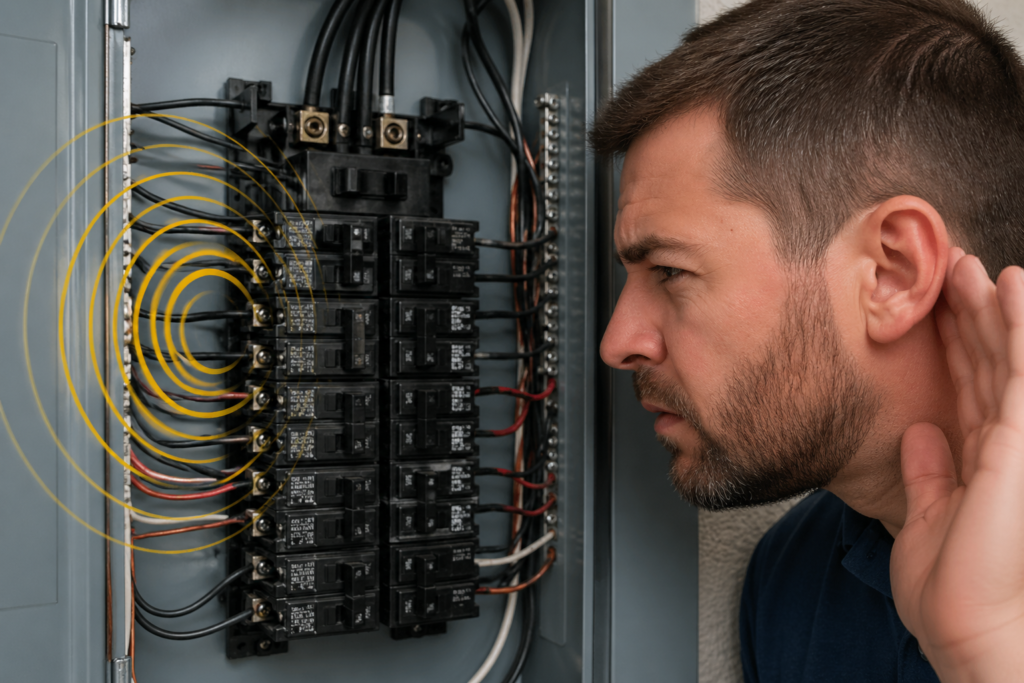
Introduction: That Sound Is Your Panel Trying to Tell You Something
You’re sitting on the couch watching the game, or maybe you’re trying to fall asleep, and then you hear it—a low, persistent hum or buzz coming from somewhere in the house. You follow the sound, and it leads you straight to your electrical panel. Now you’re standing there, staring at this metal box on the wall, wondering if your house is about to catch fire or if you’re just being paranoid. So, electrical panel buzzing what to do becomes the most important question in your mind right now.
I’m a licensed electrician who’s been crawling through basements, attics, and utility closets across the United States for the better part of two decades. I’ve heard every kind of buzz, hum, crackle, and pop that an electrical panel can make. Some sounds are harmless. Others are warning signs that something is seriously wrong and needs immediate attention. The trick is knowing the difference.
This article is going to walk you through everything you need to know about a buzzing electrical panel. We’ll cover what causes the buzzing, how to identify dangerous sounds versus normal operation, what you can safely check yourself, when you need to call a professional, and what the repair process looks like. By the time you finish reading, you’ll know exactly electrical panel buzzing what to do in your specific situation.
Whether you’re a new homeowner who just noticed the sound for the first time, someone who’s been ignoring it for months hoping it would go away, or a concerned family member trying to keep your loved ones safe, this guide is written for you. Let’s get into it.
Understanding the Sounds: Not All Buzzing Is Created Equal
Before we dive into electrical panel buzzing what to do, we need to talk about the different types of sounds your panel can make. Because here’s the truth: some buzzing is completely normal, and some buzzing means you need to evacuate your house and call the fire department. Knowing which is which could save your life.
The Normal Hum
Every electrical panel makes some sound. When electricity flows through wires and components, it creates electromagnetic fields that cause slight vibrations. These vibrations produce a very low, steady hum—almost like the sound a refrigerator makes. This is normal and nothing to worry about.
In a standard 60 Hz electrical system in the United States, that hum is typically around 120 Hz (the second harmonic of the fundamental frequency). It’s subtle, constant, and you usually only notice it if the house is quiet or if you’re standing right next to the panel. If your panel has always made this sound and it hasn’t changed, you’re probably fine.
The Breaker Buzz
Individual circuit breakers can also produce a slight buzzing sound, especially when they’re under load. If a breaker is carrying a lot of current—say, your air conditioner just kicked on, or you’re running the dryer, the dishwasher, and the microwave all at once—you might hear a faint buzz from that specific breaker. This is usually normal, though it shouldn’t be loud enough to hear from across the room.
However, if one breaker is buzzing significantly louder than the others, or if the buzz gets louder when you turn on certain appliances, that’s worth investigating further. It could indicate a loose connection, an overloaded circuit, or a breaker that’s starting to fail.
The Dangerous Arcing Buzz
Now we’re getting into the sounds that should make your hair stand up. Arcing—when electricity jumps across a gap between two conductors—produces a distinct buzzing, crackling, or sizzling sound. It’s often described as sounding like bacon frying or like a bug zapper.
Arcing is extremely dangerous because it generates intense heat—temperatures can reach 10,000 degrees Fahrenheit or higher. This heat can melt metal, ignite surrounding materials, and start electrical fires inside your walls. If you hear this kind of sound coming from your panel, you need to act immediately. This is the situation where electrical panel buzzing what to do becomes a matter of life and death.
The Loose Connection Rattle
Sometimes what sounds like buzzing is actually a loose component rattling due to vibration. A loose breaker, a loose wire, or a loose panel cover can all create rattling or vibrating sounds that might be mistaken for electrical buzzing. While not as immediately dangerous as arcing, loose connections can still create heat and fire hazards over time.
The Transformer Hum
If your panel has a built-in transformer for doorbells, low-voltage lighting, or other applications, that transformer can produce a noticeable hum. Transformers hum because the magnetic core expands and contracts slightly with each cycle of alternating current. This is normal, though it can be annoying if the transformer is mounted in a way that amplifies the sound.
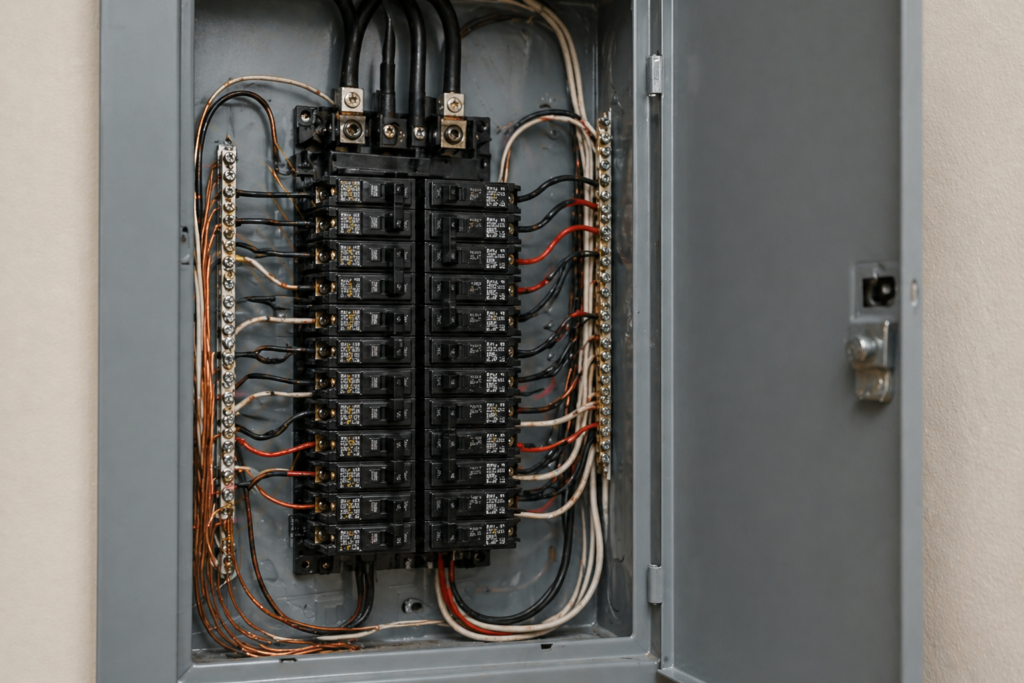
Common Causes of Electrical Panel Buzzing
Now that we understand the different types of sounds, let’s talk about what’s actually causing them. When you’re trying to figure out electrical panel buzzing what to do, identifying the root cause is the first step.
Loose Electrical Connections
This is probably the most common cause of buzzing that requires attention. When a wire isn’t tightly secured to a breaker, bus bar, or terminal, the connection has higher resistance. Electricity doesn’t flow smoothly through a loose connection—it jumps, arcs, and creates vibration. This produces the buzzing sound you’re hearing.
Loose connections can happen for several reasons:
- Improper installation by a previous electrician or DIY homeowner
- Thermal expansion and contraction over years of heating and cooling
- Vibration from nearby machinery or heavy traffic
- Corrosion weakening the connection point
- Breakers that weren’t fully seated when installed
The danger with loose connections is that they create heat. The more the connection loosens, the more resistance it has, and the hotter it gets. It’s a vicious cycle that can lead to melted components, damaged bus bars, or fire.
Failing or Defective Circuit Breakers
Circuit breakers can fail, and when they do, they often make noise. A breaker that’s internally damaged—perhaps from years of tripping, overloading, or manufacturing defects—can develop loose internal connections. These internal problems create buzzing, humming, or clicking sounds.
Some breaker brands are more prone to failure than others. Federal Pacific Electric (FPE) breakers, common in homes built from the 1950s through the 1980s, are notorious for failing to trip when they should and for developing internal faults that cause buzzing. Zinsco breakers have similar issues. If your home has one of these panel brands and you’re hearing buzzing, that’s a red flag that demands immediate attention.
Even modern breakers from reputable manufacturers like Square D, Siemens, or Eaton can fail, though it’s much less common. A breaker that’s been tripped repeatedly, overloaded, or exposed to power surges may develop internal damage.
Overloaded Circuits
When a circuit is carrying more current than it’s designed for, the breaker and wires heat up. This thermal stress can cause expansion and contraction that produces buzzing or humming sounds. You might notice the buzzing gets worse when you’re using multiple high-draw appliances on the same circuit.
Overloading is a common problem in older homes that weren’t designed for modern electrical demands. A kitchen circuit from 1960 might have been fine for a coffee maker and a toaster. Today, that same circuit might be running a microwave, an air fryer, an espresso machine, and a blender simultaneously. The breaker is working overtime, and it’s telling you about it through that buzz.
Corroded Bus Bars or Connections
Corrosion increases electrical resistance, and increased resistance creates heat and vibration. If your panel has aluminum bus bars or if it’s been exposed to moisture or humidity, corrosion could be the culprit behind your buzzing.
In coastal areas of the United States—places like Florida, Louisiana, or coastal California—salt air accelerates corrosion in electrical panels. I’ve opened panels in beach houses where the bus bars looked like they’d been underwater. The corrosion was so bad that breakers were barely making contact, and the resulting arcing was producing a constant, terrifying buzz.
Even in non-coastal areas, humidity, condensation, or water intrusion from roof leaks or plumbing problems can cause corrosion inside a panel.
Improper Breaker Installation
Not all breakers fit all panels. Breakers are designed to work with specific panel brands and models. When someone installs the wrong breaker in a panel, it might seem to fit, but it won’t make proper contact with the bus bar. This poor connection creates resistance, heat, and buzzing.
I’ve seen homeowners buy breakers at the hardware store without checking compatibility. I’ve seen handymen install whatever breaker they had in the truck. I’ve even seen electricians take shortcuts and use breakers that “mostly fit.” All of these scenarios can lead to buzzing and dangerous conditions.
Voltage Issues from the Utility
Sometimes the problem isn’t inside your panel at all—it’s coming from the utility company. If the voltage supplied to your home is too high, too low, or unstable, it can cause components in your panel to buzz or hum. Voltage fluctuations can also damage appliances and electronics throughout your home.
You can check for voltage issues with a multimeter at an outlet, but diagnosing utility-side problems usually requires coordination with your utility company and a licensed electrician.
Aging or Outdated Electrical Panels
Panels don’t last forever. As they age, components wear out, connections degrade, and the overall integrity of the system declines. An old panel with original breakers from the 1970s or 1980s is far more likely to develop buzzing issues than a modern panel.
Some older panel brands are known for problems:
- Federal Pacific Electric (FPE): Breakers often fail to trip; internal faults cause buzzing and arcing
- Zinsco/GTE-Sylvania: Aluminum bus bars corrode and melt; breakers fuse to bus bars
- Pushmatic: Breakers have weak contact points that degrade over time
- Fuse boxes: While not technically panels, old fuse systems can buzz if connections are loose
If your home has one of these systems and you’re hearing buzzing, panel replacement should be at the top of your priority list.
Immediate Steps: Electrical Panel Buzzing What to Do Right Now
Okay, so you’re standing in front of your buzzing panel. Your heart is racing. You’re Googling electrical panel buzzing what to do at 11 PM because you can’t sleep with that sound echoing through the house. Let’s talk about what you should do right now, step by step.
Step 1: Assess the Severity
First, determine how serious the situation is. Ask yourself these questions:
- Is the buzzing loud enough to hear from across the room?
- Is it a steady hum, or does it crackle, sizzle, or pop?
- Can you smell burning plastic, ozone, or something acrid?
- Are any breakers warm or hot to the touch?
- Have any breakers tripped recently for no clear reason?
- Is the buzzing coming from one specific breaker or from the entire panel?
If the sound is a faint, steady hum that you’ve noticed before and nothing else seems wrong, you can probably wait until business hours to call an electrician. But if you hear crackling, sizzling, or loud buzzing—or if you smell burning—treat it as an emergency.
Step 2: Turn Off the Main Breaker (If Safe)
If the buzzing is loud, alarming, or accompanied by other warning signs, the safest thing to do is turn off the main breaker. This will cut power to your entire house, but it will also stop the electrical flow that’s causing the buzzing and potential arcing.
Important safety note: The main lugs (where the utility wires connect to the main breaker) remain energized even when the main breaker is off. Do not touch anything inside the panel except the main breaker handle. If you’re not comfortable doing this, skip this step and call for help.
Turning off the main breaker is a temporary measure. It stops the immediate danger but doesn’t fix the underlying problem. You’ll still need an electrician to diagnose and repair the issue before restoring full power.
Step 3: Evacuate If Necessary
If you see sparks, smoke, or flames coming from the panel, evacuate your home immediately and call 911. Do not try to fight an electrical fire yourself. Once you’re safely outside, call the fire department, and then call an electrician.
If you smell strong burning but don’t see flames, turn off the main breaker if you can do so safely, evacuate, and call an electrician immediately. Even if there’s no visible fire, the internal damage might be severe enough to warrant professional emergency service.
Step 4: Document What You’re Hearing
If the situation isn’t an immediate emergency, take a moment to document the buzzing. Use your phone to record the sound. Note which breaker seems to be making the noise, if you can identify it. Write down when you first noticed the sound, whether it’s constant or intermittent, and whether it changes when you use certain appliances.
This information will be incredibly helpful when the electrician arrives. It can speed up diagnosis and ensure the problem gets fixed correctly the first time.
Step 5: Call a Licensed Electrician
For any buzzing that seems abnormal, you need a licensed electrician. Not a handyman. Not your cousin who “knows about electricity.” A licensed, insured, experienced electrician who can safely open the panel, diagnose the issue, and make proper repairs.
When you call, describe the sound as accurately as you can. Mention any other symptoms like warm breakers, burning smells, or recent electrical issues. If you recorded the sound, offer to play it for them. A good electrician will prioritize calls that involve buzzing, arcing, or burning smells because they know these can be serious.
If it’s after hours and the buzzing is concerning, many electricians offer emergency services. Yes, it costs more than a standard service call, but your safety is worth it.
What an Electrician Will Do When They Arrive
When the electrician shows up to address your electrical panel buzzing what to do situation, here’s what the diagnostic process typically looks like.
Visual Inspection
First, the electrician will look at the panel exterior, checking for signs of damage, discoloration, or improper installation. They’ll note the panel brand, amperage rating, and overall condition. If it’s a known problematic brand like FPE or Zinsco, that immediately informs their approach.
Safe Panel Opening
With the main breaker off (and sometimes with the utility company temporarily disconnecting power at the meter), the electrician will remove the panel cover. They’ll inspect the interior for:
- Burn marks or discoloration on bus bars
- Corroded or oxidized connections
- Loose wires or breakers
- Melted components
- Signs of water intrusion or pest damage
- Improper breaker types or double-tapped connections
Thermal Imaging
Many modern electricians use thermal imaging cameras to detect hot spots inside the panel. Even if something looks fine visually, it might be running hot. A thermal camera can reveal loose connections, overloaded circuits, or failing breakers that aren’t obvious to the naked eye.
I’ve found countless problems with thermal imaging that I would have missed otherwise. A connection that’s just 10 degrees hotter than its neighbors can indicate a problem that will get worse over time.
Voltage and Load Testing
The electrician will test voltage at various points in the panel to ensure proper supply from the utility. They’ll also measure current draw on individual circuits to check for overloading. This helps determine whether the buzzing is caused by utility issues, circuit problems, or panel defects.
Connection Torque Testing
Using a torque screwdriver, the electrician will check that all wire connections are tightened to the manufacturer’s specifications. Loose connections are a leading cause of buzzing, and proper torque is critical for safety. This isn’t something you can do by feel—it requires calibrated tools.
Breaker Testing
If a specific breaker seems to be the source of the buzzing, the electrician may remove it and test it with specialized equipment. They’ll check whether it trips at the correct amperage, whether internal components are damaged, and whether it’s the correct type for your panel.
Repair or Replacement Recommendations
Based on their findings, the electrician will recommend repairs. This might include:
- Tightening loose connections
- Replacing faulty breakers
- Cleaning corroded bus bars (in minor cases)
- Replacing damaged bus bars (rare; usually requires panel replacement)
- Upgrading overloaded circuits
- Full panel replacement (if the panel is outdated or severely damaged)
They should explain what they found, show you photos or thermal images, and give you a clear estimate before starting work.
Repair Options and What They Cost
Let’s talk money. When you’re dealing with electrical panel buzzing what to do, the cost of repairs is probably on your mind. Here’s a realistic breakdown of what you might pay for different scenarios in the United States.
Minor Repairs: $150 – $400
If the issue is simply loose connections that need proper tightening, or a single faulty breaker that needs replacement, you’re looking at a relatively inexpensive service call. The electrician’s hourly rate (typically $75-$150 per hour depending on your location) plus the cost of a new breaker ($10-$50) will cover it.
This is the best-case scenario, and it’s more common than you might think. Sometimes a panel just needs a little TLC after years of settling and thermal cycles.
Breaker Replacement: $200 – $500
If multiple breakers need replacement, or if you need specialized breakers like AFCI or GFCI models, costs go up. AFCI breakers, which are now required by code for most residential circuits, typically cost $40-$80 each compared to $10-$20 for standard breakers.
If your electrician discovers that previous DIY work installed the wrong brand of breakers, and all of them need to be swapped out for proper ones, you could be looking at the higher end of this range.
Circuit Troubleshooting and Repair: $300 – $800
If the buzzing is caused by overloaded circuits, damaged wiring, or problems somewhere between the panel and your outlets, the electrician will need to trace circuits, test loads, and potentially rewire portions of your home. This takes time and expertise, which translates to higher labor costs.
Panel Replacement: $1,500 – $3,500
If your panel is outdated, severely damaged, or simply inadequate for your electrical needs, replacement is the only safe option. This involves:
- New panel with copper or quality aluminum bus bars
- New main breaker
- Proper grounding system
- Permitting and inspection
- Potential utility coordination for temporary disconnect
In high-cost areas like San Francisco, New York, or Chicago, panel replacement can push toward $4,000 or more. In more affordable markets, you might get it done for closer to $1,200.
Emergency Service Premium
If you need an electrician to come out at night, on weekends, or during holidays, expect to pay 1.5x to 2x the standard rate. Emergency electrical issues involving buzzing, arcing, or burning smells are legitimate emergencies, but they do cost more.
Preventing Future Buzzing Problems
Once you’ve resolved your current buzzing issue, you’ll want to prevent it from happening again. Here are the best practices I recommend to my clients across the United States.
Regular Professional Inspections
Have a licensed electrician inspect your panel every 3-5 years, or more frequently if your home is over 30 years old. They can catch loose connections, corrosion, and wear before they become buzzing problems.
Avoid Overloading Circuits
Be mindful of what you’re plugging into each circuit. Don’t run space heaters, hair dryers, and vacuum cleaners on the same circuit simultaneously. If you find yourself constantly tripping breakers or hearing buzzing when using certain combinations of appliances, it’s time to add circuits or upgrade your service.
Use the Right Breakers
Never install breakers that aren’t specifically listed for your panel model. Check the panel label for approved breaker types, and if you’re unsure, ask an electrician or the manufacturer. The few dollars you save by buying the wrong breaker aren’t worth the fire risk.
Keep the Panel Area Clear
Don’t store items against or in front of your electrical panel. The National Electrical Code requires clear working space for a reason—accessibility for maintenance and safety in emergencies. Plus, clutter can trap heat and reduce ventilation.
Monitor for Changes
Pay attention to your panel. If the normal hum changes pitch, gets louder, or is joined by new sounds, investigate promptly. The sooner you catch a problem, the simpler and cheaper it is to fix.
Upgrade When Necessary
If your panel is over 25-30 years old, or if it’s a known problematic brand, start budgeting for replacement. Don’t wait for a buzzing crisis to force your hand. Proactive upgrades are safer and often less expensive than emergency replacements.
Address Moisture Issues
If your panel is in a damp basement, garage, or utility room, address the moisture source. Install a dehumidifier, fix leaks, or improve ventilation. Moisture is the enemy of electrical components, especially aluminum bus bars.
Special Cases: When Buzzing Means Something Specific
Sometimes the buzzing pattern or timing can tell you exactly what’s wrong. Here are some special cases I’ve encountered in my years of electrical work.
Buzzing Only When the AC Turns On
If you hear buzzing from the panel every time your air conditioner starts up, the issue is likely with the AC circuit breaker or the connection to the AC disconnect. Air conditioners draw a large inrush current when they start, which can stress weak connections. The breaker might be undersized, loose, or failing.
Buzzing That Stops When You Turn Off a Specific Breaker
This is actually helpful for diagnosis. If you can identify which breaker stops the buzzing when turned off, you’ve isolated the problem circuit. The issue could be the breaker itself, the connection to the bus bar, or something downstream on that circuit. Either way, you’ve given the electrician a huge head start.
Buzzing That Gets Worse in Summer
Heat makes electrical problems worse. When ambient temperatures rise, panels run hotter, connections expand, and resistance increases. If your buzzing is seasonal, it might indicate a panel or circuit that’s borderline overloaded and only reveals itself under thermal stress.
Intermittent Buzzing That Comes and Goes
Intermittent buzzing is often caused by something that only happens occasionally—a loose connection that arcs under certain loads, a failing breaker that only buzzes when it’s warm, or a utility voltage fluctuation that occurs during peak demand periods. These can be tricky to diagnose because the problem isn’t present when the electrician arrives. Recording the sound and noting when it happens can help tremendously.
Buzzing After a Storm or Power Surge
If your panel started buzzing after a lightning storm, power outage, or utility surge, you might have component damage. Surges can weaken breakers, damage bus bar connections, and create internal faults that manifest as buzzing. Always have your panel inspected after significant electrical events.
The Connection Between Buzzing and Fire Risk
I want to be very clear about this because it’s the most important thing in this entire article. Electrical panel buzzing is often a warning sign of conditions that can lead to fire. Understanding this connection is central to electrical panel buzzing what to do.
How Electrical Fires Start
Most residential electrical fires don’t start with dramatic sparks and flames. They start with heat. A loose connection creates resistance. Resistance creates heat. Heat degrades the connection further, which creates more resistance and more heat. Eventually, the temperature gets high enough to ignite nearby materials—wood framing, insulation, dust, or the plastic components inside the panel itself.
This process can take months or even years. The buzzing you’re hearing might be the sound of this slow-motion disaster in progress. That’s why ignoring buzzing is never a good idea.
Arc Faults and Arcing Buzzes
Arc faults are particularly dangerous because they can occur at current levels too low to trip a standard breaker. The electricity arcs across a gap, creating temperatures hot enough to melt copper and start fires, but not drawing enough current to trigger overcurrent protection. This is exactly why modern electrical codes require Arc Fault Circuit Interrupter (AFCI) breakers for most residential circuits.
If you have an older panel without AFCI protection and you’re hearing arcing-type buzzing, you’re at higher risk because your breakers might not trip even as dangerous arcing occurs.
Statistics on Electrical Fires
According to the National Fire Protection Association (NFPA), electrical distribution systems are involved in roughly 30,000 home fires per year in the United States, resulting in hundreds of deaths and over a billion dollars in property damage. Many of these fires originate in panels, breakers, or connections that showed warning signs before the fire started.
Buzzing, humming, warm breakers, and burning smells are among the most common warning signs reported by survivors of electrical fires. Don’t be the person who wishes they’d called an electrician sooner.
When to Replace vs. When to Repair
A big part of electrical panel buzzing what to do is deciding whether the situation calls for repair or full replacement. Here’s how I guide my clients through that decision.
Repair Is Appropriate When:
- The panel is less than 20 years old and from a reputable manufacturer
- The buzzing is caused by a single loose connection or one faulty breaker
- The bus bars are in good condition with no corrosion, melting, or pitting
- The panel has adequate capacity for your current and future electrical needs
- There are no signs of water damage, pest infestation, or physical damage
- The panel uses properly listed breakers and has no code violations
Replacement Is Necessary When:
- The panel is over 30-40 years old
- It’s a known problematic brand (FPE, Zinsco, Pushmatic)
- The bus bars are corroded, melted, or physically damaged
- Multiple breakers are failing or improperly installed
- The panel is undersized for your home’s electrical load
- There are signs of water damage, burning, or arcing inside the panel
- Your insurance company requires replacement
- You’re planning major renovations or adding significant electrical load
The Upgrade Conversation
Even if your panel can be repaired, it might still be worth upgrading if:
- You’re planning to stay in your home for many years
- You want to add EV charging, solar, or a home workshop
- Your current panel is near capacity
- You want the peace of mind of modern safety features like AFCI and GFCI protection
- You’re concerned about resale value and home inspection findings
I always tell my clients: a panel upgrade is an investment in safety and future-proofing. It’s not just about fixing today’s buzzing—it’s about preventing tomorrow’s problems.
DIY Checks You Can Do (Safely)
While I strongly recommend leaving panel work to professionals, there are some safe checks you can perform as a homeowner. These can help you gather information and determine whether you need emergency service.
The Listen Test
Stand near your panel in a quiet house and listen carefully. Can you locate the source of the buzzing? Is it coming from a specific breaker, from the main breaker area, or from the entire panel? Use a wooden spoon or dowel as a stethoscope—place one end against the panel and the other against your ear. This can help pinpoint the sound without touching anything electrical.
The Visual Check (Panel Closed)
Look at the panel exterior. Are there scorch marks, discoloration, or rust? Is the cover properly secured? Can you see any wires entering the panel that look damaged or frayed? These observations can be valuable information for your electrician.
The Breaker Touch Test (Use Extreme Caution)
With the panel cover closed, you can gently touch the breaker handles to see if any feel warm. Do not open the panel cover for this. If a breaker feels distinctly warmer than the others, that could indicate a problem. However, breakers do run warm under normal load, so this test is subjective. When in doubt, assume there’s a problem.
The Appliance Correlation Test
Turn off appliances one by one and listen to whether the buzzing changes. If the buzzing stops when you turn off the air conditioner, you know the AC circuit is involved. This doesn’t tell you exactly what’s wrong, but it narrows down the search.
What You Should NEVER Do
- Never remove the panel cover unless you’re a licensed electrician
- Never touch any wires, bus bars, or terminals inside the panel
- Never try to tighten connections yourself
- Never spray anything into the panel (no WD-40, no cleaners, no water)
- Never ignore buzzing that concerns you, hoping it will go away
Understanding Your Homeowner’s Insurance and Electrical Panels
Something many homeowners don’t realize is that your electrical panel can affect your insurance coverage. When you’re dealing with electrical panel buzzing what to do, insurance considerations might influence your timeline and decisions.
Panels That Insurance Companies Hate
Many insurance companies in the United States refuse to write policies for homes with certain panel brands, or they charge significantly higher premiums. The most commonly blacklisted panels are:
- Federal Pacific Electric (FPE) Stab-Lok panels
- Zinsco/Sylvania panels
- Fuse boxes (in some cases)
- Panels with known recalls or safety alerts
If you have one of these panels and you’re hearing buzzing, your insurance company might require replacement as a condition of continued coverage. Some insurers send inspectors to evaluate homes before writing policies, and a problematic panel can be an immediate dealbreaker.
Claims and DIY Work
If you have unpermitted electrical work in your home and a fire occurs, your insurance company may deny your claim. This is another reason to always hire licensed electricians for panel work and to ensure proper permits are pulled. The money you save by hiring an unlicensed handyman could cost you your entire home if something goes wrong.
Documentation for Claims
If buzzing leads to damage that you need to claim on insurance, documentation is key. Keep records of:
- When you first noticed the buzzing
- Any electrician inspections or evaluations
- Photos or videos of the panel and any damage
- Repair estimates and invoices
- Communication with your insurance company
Preventive Upgrades and Premium Discounts
Some insurance companies offer discounts for homes with modern electrical systems, updated panels, and safety features like AFCI breakers and whole-house surge protectors. If you’re already considering a panel upgrade, ask your insurance agent whether it might qualify you for a discount.
Regional Considerations Across the United States
Electrical issues and solutions can vary depending on where you live. Here are some regional factors to consider when thinking about electrical panel buzzing what to do.
Hot and Humid Climates (Florida, Gulf Coast, Southeast)
Heat and humidity are hard on electrical panels. Condensation can form inside panels, especially in unconditioned spaces like garages. Corrosion happens faster. Breakers and bus bars run hotter. If you live in these areas, you should inspect your panel more frequently and consider panels with corrosion-resistant features.
Cold Climates (Northeast, Upper Midwest)
Extreme cold can make metal brittle, though this is rarely an issue for indoor panels. However, panels in unheated garages or outbuildings in places like Minnesota, Wisconsin, or Maine can experience thermal stress from wide temperature swings. Also, heating loads in these regions are substantial, which means panels work harder in winter.
Seismic Zones (California, Pacific Northwest)
In earthquake-prone areas, panels must be securely mounted to withstand shaking. Loose panels can stress connections and create buzzing. If you live in these areas, ensure your panel is properly anchored and that flexible conduit is used where appropriate.
Older Urban Housing (Northeast, Midwest)
Cities like Boston, Philadelphia, Baltimore, Chicago, and Detroit have vast stocks of older housing with original electrical systems. Knob-and-tube wiring, cloth-insulated wires, and outdated panels are common. If you own an older home in these areas, panel buzzing should be taken very seriously because the underlying system may be at the end of its useful life.
Rural Areas
Rural homes often have longer service runs from the utility, which can result in voltage fluctuations. Well pumps, barns, workshops, and outbuildings add electrical complexity. If you’re in a rural area and hearing panel buzzing, consider whether voltage issues or overloaded service capacity might be contributing factors.
The Future of Electrical Panels and Smart Monitoring
The electrical industry is evolving, and new technologies are changing how we monitor and maintain panels. These innovations can help catch buzzing-causing problems before they become dangerous.
Smart Electrical Panels
Companies like Span, Schneider Electric, and Leviton are producing “smart” panels that include digital monitoring of each circuit. These panels can:
- Track energy usage in real-time
- Detect abnormal current draws that might indicate loose connections
- Alert you to problems via smartphone apps
- Allow remote control of individual circuits
- Integrate with solar, battery storage, and EV charging
While smart panels are more expensive than traditional panels, they offer unprecedented visibility into your electrical system. Some can even detect the subtle current signatures that precede arcing faults, potentially warning you before buzzing starts.
Thermal Monitoring Systems
Standalone thermal monitoring devices can be installed in existing panels to track temperature trends. If a connection starts heating up, you’ll get an alert. This is a more affordable way to add monitoring without replacing the entire panel.
Predictive Maintenance
The concept of predictive maintenance—using data and sensors to predict when components will fail—is coming to residential electrical systems. Instead of waiting for buzzing or a breaker trip, these systems analyze patterns and recommend maintenance before problems develop.
Integration with Home Automation
Modern electrical panels can integrate with home automation systems, allowing you to monitor energy usage, receive alerts, and even shed loads automatically during peak demand periods. This technology is particularly valuable for homes with solar panels, battery backups, and time-of-use utility rates.
Real Stories from the Field: Buzzing Panels I’ve Fixed
Let me share a few real-world examples from my career that illustrate the variety of buzzing scenarios and outcomes.
The Historic Brownstone in Brooklyn
I got a call from a homeowner in Park Slope who heard a loud buzzing from their basement panel every time they ran the dishwasher and microwave simultaneously. The panel was a 100-amp Federal Pacific from the 1960s. When I opened it, the bus bars were severely corroded, and two breakers were literally melted into their stabs. The buzzing was arcing between the damaged breaker and the compromised bus bar.
We did a full service upgrade: 200-amp panel, new meter socket, new grounding, and rewiring of the overloaded kitchen circuits. The homeowner’s insurance company had actually threatened to cancel their policy if they didn’t replace the FPE panel. The buzzing was a blessing in disguise—it forced them to address a serious hazard before it caused a fire.
The Arizona Desert Home
A client in Phoenix called about a panel that buzzed loudly every afternoon during summer. The panel was in the garage, where temperatures regularly exceeded 110 degrees. The heat was causing thermal expansion in the aluminum bus bars, which loosened breaker connections. Every afternoon, as the garage heated up, the connections would arc and buzz.
We relocated the panel to a climate-controlled interior wall and upgraded to a panel with copper bus bars. The buzzing stopped immediately, and the homeowner saw a reduction in their electric bill because the panel was no longer wasting energy through resistive heating.
The Michigan Lake House
A family in northern Michigan had a vacation home where the panel buzzed intermittently, usually during storms. Investigation revealed that water was entering the panel through a poorly sealed service entrance cable. The moisture caused corrosion on the bus bars, and when the wind blew during storms, it would shift the water around and change the connection dynamics, causing intermittent arcing and buzzing.
We sealed the service entrance, installed a new panel with proper weatherproofing, and added a whole-house surge protector. The buzzing never returned, and the family could enjoy their lake house without worrying about electrical fires.
The DIY Nightmare in Texas
A homeowner in Dallas watched YouTube videos and decided to add circuits to his own panel. He bought breakers that weren’t listed for his panel brand and forced them onto the bus bars. Within a week, he heard constant buzzing and smelled burning. When I opened the panel, three bus bar stabs were destroyed, and the insulation on multiple wires was melted.
The entire panel needed replacement. What should have been a $200 service call turned into a $2,800 panel upgrade. The homeowner told me he wished he’d spent the money on a professional in the first place. I hear that a lot.
Frequently Asked Questions About Electrical Panel Buzzing
Here are the questions I get most often from homeowners dealing with buzzing panels.
Is it normal for an electrical panel to buzz?
A very faint, steady hum is normal. Loud buzzing, crackling, sizzling, or popping is not normal and requires investigation.
Can a buzzing panel cause a fire?
Yes. Buzzing often indicates arcing, loose connections, or component failure—all of which can generate enough heat to start a fire.
Should I turn off the main breaker if my panel is buzzing?
If the buzzing is loud or alarming, yes, turn off the main breaker if you can do so safely. Then call an electrician. If you see sparks or smell burning, evacuate and call 911.
How much does it cost to fix a buzzing electrical panel?
Minor repairs might cost $150-$400. Breaker replacement could be $200-$500. Full panel replacement typically runs $1,500-$3,500 depending on your location and the complexity of the job.
Can I fix a buzzing panel myself?
No. Working inside an electrical panel is extremely dangerous and should only be done by a licensed electrician. Even with the main breaker off, some components remain energized.
Will my homeowners insurance cover panel replacement?
It depends on your policy and the cause of the damage. Damage from sudden, accidental events is often covered. Damage from gradual wear, pre-existing conditions, or unpermitted DIY work usually is not.
How long does a panel replacement take?
Most residential panel replacements take one to two days, plus time for permitting and inspection.
What brands of panels should I avoid?
Federal Pacific Electric (FPE) Stab-Lok, Zinsco/Sylvania, and outdated Pushmatic panels are considered problematic. Most electricians recommend replacing them.
Can I just replace the buzzing breaker?
Sometimes, yes. But if the buzzing is caused by bus bar damage, loose wiring, or panel defects, replacing the breaker won’t solve the underlying problem. A professional diagnosis is essential.
How often should I have my panel inspected?
Every 3-5 years for modern panels, or more frequently if your home is over 30 years old or if you notice any warning signs like buzzing, warm breakers, or burning smells.
Conclusion: Don’t Ignore the Buzz
So, electrical panel buzzing what to do? The answer is simple: take it seriously, assess the severity, and call a licensed electrician if there’s any doubt. A faint hum is normal. Anything more than that deserves attention.
Your electrical panel is the heart of your home’s power system. It works 24/7, silently distributing electricity to every light, outlet, and appliance. When it starts making noise, it’s trying to tell you something. Listen to it.
I’ve seen too many cases where homeowners ignored buzzing for months, hoping it would go away, only to end up with damaged panels, tripped breakers, or worse—electrical fires that could have been prevented. The cost of an electrician’s service call is nothing compared to the cost of rebuilding your home or, heaven forbid, losing a family member.
If you’re hearing buzzing right now, don’t finish this article and go back to watching TV. Go listen to your panel. If something doesn’t sound right, pick up the phone and call a licensed electrician in your area. In the United States, you can find qualified electricians through your state’s licensing board, the Better Business Bureau, or reputable review sites.
Remember: electricity is invisible, silent, and deadly when something goes wrong. The buzzing is your warning. Don’t waste it.
Stay safe out there.