
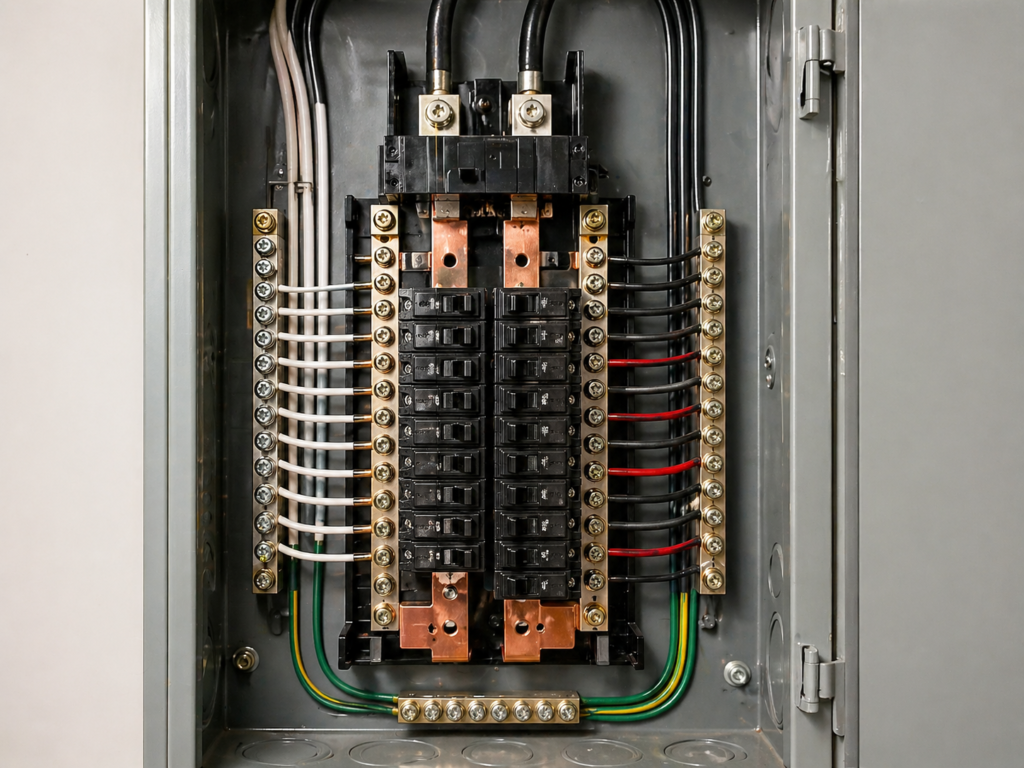
The Heart of Your Home’s Electrical System
If you’ve ever opened your electrical panel and stared at the maze of wires, breakers, and metal strips, you’ve probably wondered what everything does. One of the most important—but least understood—components in there is the bus bar. So, what is a bus bar in an electrical panel? It’s a solid metal strip or bar that distributes electricity to all the circuit breakers in your panel, acting like the central highway that feeds power to every room in your house.
I’m a licensed electrician based in the United States, and I’ve spent years crawling through attics, basements, and crawl spaces from Texas to Michigan, fixing panels, upgrading services, and explaining to homeowners why their lights keep flickering. I’ve seen bus bars that were corroded, overloaded, and in some cases, dangerously outdated. This article is going to break down everything you need to know about bus bars—what they are, how they work, why they matter, and when they need attention.
Whether you’re a new homeowner trying to understand your electrical system, a DIY enthusiast who wants to know what’s safe to touch and what isn’t, or someone dealing with electrical issues and trying to figure out if your panel is the culprit, this guide is for you. By the end, you’ll understand what is a bus bar in an electrical panel better than most people who’ve lived in their homes for decades.
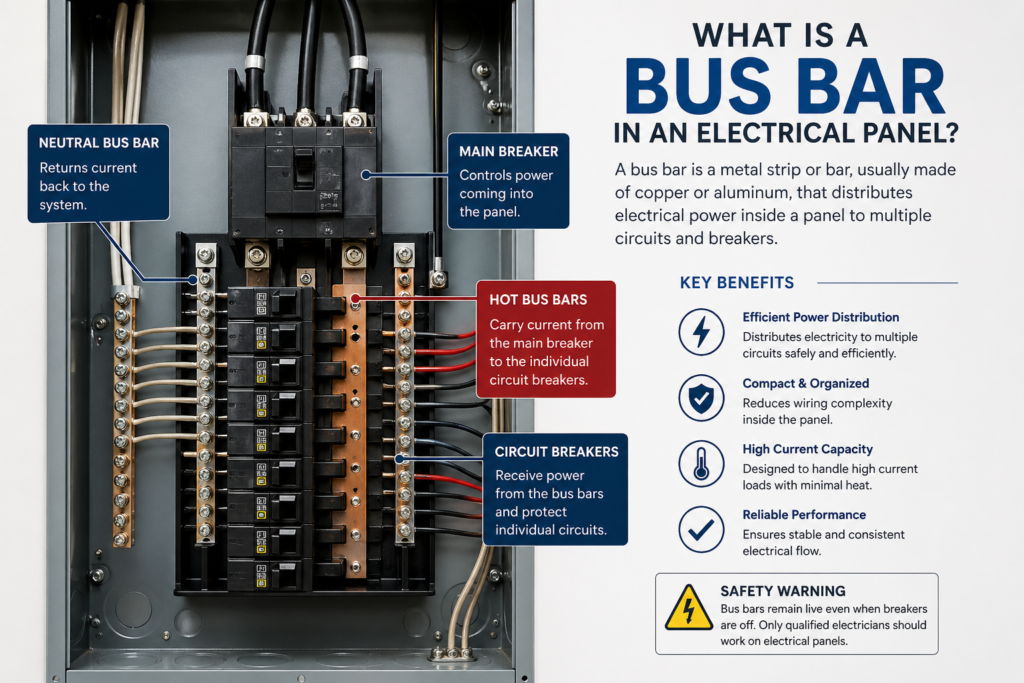
What Is a Bus Bar in an Electrical Panel?
Let’s start with the basics. What is a bus bar in an electrical panel? A bus bar is a conductive metal strip—usually made of copper or aluminum—that serves as a central connection point for electrical power distribution inside your panel. Think of it as the main artery of your home’s electrical system. Power comes in from your utility company through the main service wires, hits the main breaker, and then flows into the bus bars. From there, the bus bars distribute that power to each individual circuit breaker, which then sends electricity to specific areas of your home.
Bus bars are typically flat, rectangular pieces of metal that run vertically or horizontally inside the panel. In a standard residential panel in the United States, you’ll usually find two bus bars—one for each hot leg of your 240-volt service. Each circuit breaker clips onto these bus bars, creating a secure electrical connection. When you flip a breaker on, it bridges the gap between the bus bar and the circuit wires, allowing electricity to flow.
The term “bus bar” comes from the Latin word “omnibus,” meaning “for all.” And that’s exactly what it does—it provides power for all your circuits. Without bus bars, there would be no efficient way to distribute electricity from a single incoming source to multiple outgoing circuits. Every time you turn on a light, charge your phone, or run your dishwasher, that power has passed through a bus bar at some point.
In older homes across America, especially those built before the 1980s, you might encounter different types of bus bars and panel designs. Some older panels, like Federal Pacific or Zinsco models, have bus bar designs that are known to be problematic and are no longer considered safe by modern standards. If you live in an older home, understanding what is a bus bar in an electrical panel could literally be a matter of safety.
How Bus Bars Actually Work in Your Electrical Panel
Understanding what is a bus bar in an electrical panel is one thing, but understanding how it actually functions is another. Let me walk you through the process in simple terms.
When electricity enters your home from the utility pole or underground service, it typically comes in as 240 volts split into two 120-volt legs. These wires connect to your main breaker, which acts as the master shutoff switch for your entire house. From the main breaker, the electricity flows into the bus bars.
In a typical residential panel, you’ll see two vertical bus bars running parallel to each other. These are the hot bus bars. Each one carries 120 volts relative to neutral, and together they provide 240 volts for large appliances like your air conditioner, electric dryer, or water heater. Standard single-pole breakers for your lights and outlets connect to just one bus bar, delivering 120 volts. Double-pole breakers for large appliances connect to both bus bars, pulling 240 volts.
The bus bars are designed to handle a specific amount of electrical current, measured in amperes (amps). A 200-amp panel, which is standard for most modern American homes, has bus bars rated to safely carry 200 amps of continuous current. If you try to draw more power than the bus bars are rated for, you risk overheating, which can lead to melted components, fire hazards, or complete system failure.
The physical connection between the breaker and the bus bar is critical. When a breaker is properly seated on the bus bar, it creates a tight, low-resistance connection. Over time, however, this connection can degrade. Heat expansion and contraction, corrosion, or loose connections can increase resistance at the contact point. When resistance goes up, heat goes up. That’s why you’ll sometimes hear about electrical fires starting at the bus bar connections—it’s not the bus bar itself failing, but the connection between the bus bar and the breaker becoming compromised.
I remember a job I did in Ohio where a homeowner’s lights were flickering intermittently. When I opened the panel, I found that one of the bus bar stabs (the points where breakers connect) was severely burned and pitted. The breaker had been loose for who knows how long, creating arcing every time the connection heated up and cooled down. We had to replace the entire panel because the bus bar damage was too extensive to repair safely. That’s the kind of thing that happens when people ignore the warning signs.
Types of Bus Bars You’ll Find in American Electrical Panels
Not all bus bars are created equal. When you’re trying to understand what is a bus bar in an electrical panel, it’s helpful to know that there are different types designed for different applications and panel configurations.
Copper Bus Bars
Copper bus bars are the gold standard in electrical panels, and for good reason. Copper has excellent electrical conductivity—second only to silver among common metals. It also resists corrosion better than aluminum and maintains a stable connection over time. Most high-quality panels manufactured by companies like Square D, Siemens, and Eaton use copper bus bars. If you’re upgrading your panel or building a new home in the United States, copper bus bars are what you want.
Copper bus bars are more expensive than aluminum, which is why you’ll find them in premium panels and commercial applications. But for residential use, the extra cost is usually worth it for the peace of mind and longevity. A copper bus bar can last the lifetime of the panel if it’s not overloaded or physically damaged.
Aluminum Bus Bars
Aluminum bus bars are lighter and less expensive than copper, which made them popular in panels manufactured during the 1960s and 1970s, particularly during the copper shortages of that era. However, aluminum has some drawbacks. It expands and contracts more than copper with temperature changes, which can loosen connections over time. It also forms an oxide layer when exposed to air, which increases resistance at connection points.
That said, modern aluminum bus bars are often treated or alloyed to reduce these issues. Some manufacturers use tin-plated aluminum to improve conductivity and reduce oxidation. If you have an older panel with aluminum bus bars, it doesn’t automatically mean it’s dangerous, but it does mean you should have it inspected more regularly by a licensed electrician.
Tin-Plated Copper Bus Bars
Some manufacturers plate their copper bus bars with tin to provide additional corrosion resistance. This is especially useful in humid climates or coastal areas where salt air can accelerate corrosion. Tin plating doesn’t significantly reduce conductivity, and it can extend the life of the bus bar in harsh environments. I’ve seen these in panels installed in Florida and Louisiana, where the humidity is relentless.
Solid vs. Stranded Bus Bars
While most bus bars are solid pieces of metal, some specialized applications use stranded or flexible bus bars. These are more common in industrial settings or in panels that need to accommodate vibration or movement. For residential electrical panels in the United States, you’ll almost always encounter solid bus bars.
Single-Phase vs. Three-Phase Bus Bars
Residential homes in the United States use single-phase power, which means there are two hot bus bars (each 120V) and one neutral bus bar. Commercial and industrial buildings often use three-phase power, which requires three hot bus bars. If you’re a homeowner, you only need to worry about the single-phase configuration, but it’s good to know the difference if you’re ever looking at commercial equipment or talking to an electrician about a workshop or garage setup.
The Neutral Bus Bar: An Important Cousin
When discussing what is a bus bar in an electrical panel, we can’t ignore the neutral bus bar. While the hot bus bars distribute power to your circuits, the neutral bus bar provides the return path for electricity to complete the circuit.
In a standard 120-volt circuit, electricity flows from one of the hot bus bars, through the hot wire, to your light or appliance, and then returns through the neutral wire to the neutral bus bar. The neutral bus bar is connected to the main service neutral and is also bonded to the ground bus bar and the panel enclosure in the main service panel. This bonding is what creates the ground reference for your entire electrical system.
In subpanels—additional panels that are fed from the main panel—the neutral bus bar must be isolated from the ground bus bar and the panel enclosure. This is a common point of confusion and a frequent code violation I encounter in older homes. If the neutral and ground are bonded in a subpanel, it can create parallel paths for current to flow, which is a safety hazard.
The neutral bus bar is typically a strip with multiple screws or clamps where neutral wires from each circuit are connected. It’s usually made of aluminum or copper, similar to the hot bus bars. In some panels, the neutral and ground bus bars are combined into a single assembly, while in others they’re separate strips.
Understanding the relationship between hot bus bars, neutral bus bars, and ground connections is crucial for anyone working on electrical systems. It’s not just about knowing what is a bus bar in an electrical panel—it’s about understanding how all the pieces work together to create a safe, functional electrical system.
Common Bus Bar Problems and Warning Signs
Now that we’ve covered what is a bus bar in an electrical panel and how it works, let’s talk about what can go wrong. As an electrician, I’ve seen my fair share of bus bar issues, and they range from minor annoyances to serious fire hazards.
Loose Connections
The most common problem with bus bars is loose connections where the breakers attach. As I mentioned earlier, the constant heating and cooling of electrical connections can cause metal to expand and contract. Over time, this can loosen the grip between the breaker and the bus bar. A loose connection creates resistance, which generates heat. Heat further degrades the connection, creating a vicious cycle that can lead to melted breakers, damaged bus bars, or even electrical fires.
Warning signs of loose bus bar connections include:
- Breakers that feel warm or hot to the touch
- A burning smell coming from the panel
- Discoloration or scorch marks on breakers or bus bars
- Flickering lights or intermittent power loss
- Breakers that trip frequently for no apparent reason
If you notice any of these signs, call a licensed electrician immediately. Do not attempt to tighten connections yourself unless you know exactly what you’re doing and have the proper training.
Corrosion and Oxidation
Corrosion is another enemy of bus bars, especially in humid climates or in panels that have been exposed to moisture. Corroded bus bars have higher resistance, which means they generate more heat under load. In severe cases, corrosion can eat away at the metal, reducing its current-carrying capacity and creating weak points.
Aluminum bus bars are particularly susceptible to oxidation. When aluminum oxidizes, it forms a white or gray powdery substance on the surface. This oxide layer is actually an insulator, meaning it resists electrical flow. If you see white buildup on aluminum bus bars, that’s a red flag.
Overloading
Every bus bar has a maximum current rating. In a 200-amp panel, the bus bars are designed to handle 200 amps continuously. If you add too many high-draw circuits or if your overall electrical demand exceeds the panel’s capacity, the bus bars can overheat.
Overloading is more common than you might think, especially in older homes that have been renovated without upgrading the electrical service. I’ve been in houses where the original 100-amp panel was still in place, but the homeowners had added central air, electric dryers, hot tubs, and kitchen renovations. The bus bars were running hot enough to cook an egg.
Physical Damage
Bus bars can be physically damaged by improper breaker installation, foreign objects falling into the panel, or attempted DIY repairs. I’ve seen panels where someone tried to force a breaker from one manufacturer into a panel made by another company. The breaker didn’t fit properly, and in the process of jamming it in, they damaged the bus bar stab. That panel needed to be replaced.
Physical damage can also occur during renovations or when panels are moved. Bus bars are sturdy, but they’re not indestructible. A significant impact can bend or crack them, creating a serious safety issue.
Outdated or Recalled Panels
Some older electrical panels have bus bar designs that are inherently problematic. Two notable examples in the United States are Federal Pacific Electric (FPE) panels and Zinsco panels.
Federal Pacific panels, common in homes built from the 1950s through the 1980s, have been found to have defective breakers that fail to trip when they should. But the bus bar design in these panels is also problematic. The breakers often don’t make proper contact with the bus bars, leading to arcing and overheating. Many insurance companies won’t insure homes with FPE panels, and most electricians recommend replacing them.
Zinsco panels, also known as GTE-Sylvania panels, have aluminum bus bars that are prone to corrosion and melting. The breakers in these panels can fuse to the bus bars, making them impossible to remove without damaging the panel. Like FPE panels, Zinsco panels are considered a fire hazard and should be replaced.
If your home has one of these panels, understanding what is a bus bar in an electrical panel takes on extra urgency. These are not panels you want to live with.
When Should You Replace or Upgrade Your Bus Bars?
This is a question I get a lot from homeowners. The short answer is: bus bars themselves are rarely replaced independently of the panel. In most cases, if the bus bars are damaged, corroded, or inadequate for your electrical needs, the entire panel needs to be replaced.
Here are the scenarios where panel replacement—and therefore new bus bars—is necessary:
Your Panel Is Over 25-30 Years Old
Electrical panels don’t last forever. While the bus bars themselves might still be functional after 30 years, the breakers, connections, and overall design may not meet modern safety standards. If your panel is pushing 40 or 50 years old, it’s time to start thinking about an upgrade. This is especially true if you have an older brand like Federal Pacific, Zinsco, or Pushmatic.
You’re Adding Significant Electrical Load
If you’re planning a major renovation, adding an addition, installing a hot tub, or upgrading to electric heating, your existing panel and bus bars may not be able to handle the increased demand. Most modern homes need at least a 200-amp service. If you’re still running on 100 amps, you’ll need to upgrade the panel, which means new bus bars rated for the higher capacity.
You’ve Experienced Electrical Issues
Frequent breaker trips, flickering lights, burning smells, or warm breakers are all signs that something is wrong inside your panel. These symptoms could indicate bus bar problems, breaker problems, or both. An electrician can diagnose the issue and determine if panel replacement is necessary.
You’re Selling Your Home
Many home inspectors flag outdated or undersized electrical panels during pre-sale inspections. Having a modern panel with properly rated bus bars can make your home more attractive to buyers and prevent last-minute negotiation headaches. In some markets, insurance companies require panel upgrades before they’ll write a policy.
Your Insurance Company Requires It
Speaking of insurance, some companies are getting stricter about the types of panels they’ll cover. If you have a known problematic panel brand, your insurance company may require replacement as a condition of coverage. This is becoming more common with FPE and Zinsco panels.
The Process of Replacing an Electrical Panel and Bus Bars
If you’ve determined that your panel needs to be replaced, you might be wondering what the process looks like. As someone who’s done hundreds of panel upgrades across the United States, I can walk you through it.
Step 1: Assessment and Permitting
First, a licensed electrician will assess your current electrical system, calculate your load requirements, and determine the appropriate panel size. In most jurisdictions, a permit is required for panel replacement. Your electrician should handle the permitting process, which typically involves submitting plans to the local building department.
Step 2: Scheduling with the Utility Company
In many cases, the utility company needs to disconnect power to your home during the panel replacement. This is usually done at the meter or at the utility pole. Your electrician will coordinate with the utility to schedule a temporary disconnect and reconnect. In some areas, this can be done same-day, while in others it might take a few days to schedule.
Step 3: Removal of the Old Panel
On the day of the upgrade, the power is shut off, and the old panel is carefully removed. All the circuit wires are labeled so they can be properly reconnected to the new panel. This is a critical step—improper labeling can lead to circuits being connected to the wrong breakers, which creates safety hazards and code violations.
Step 4: Installation of the New Panel
The new panel, complete with fresh bus bars, is mounted and wired. The main service wires are connected, the breakers are installed, and each circuit is properly routed. The electrician will also ensure that the grounding system is up to code, which may involve adding or upgrading ground rods.
Step 5: Inspection
After installation, the work must be inspected by the local authority having jurisdiction (usually the building inspector or electrical inspector). The inspector will verify that the panel is properly installed, that the bus bars and breakers are correctly rated, and that all connections are secure.
Step 6: Power Restoration
Once the inspection passes, the utility company restores power, and your new panel is ready to go. The whole process typically takes one to two days, though permitting and inspection scheduling can extend the timeline.
A panel upgrade in the United States typically costs between $1,500 and $3,000 for a standard 200-amp replacement, though prices can vary significantly based on location, accessibility, and the complexity of the installation.
Bus Bars and Electrical Code Requirements
Understanding what is a bus bar in an electrical panel also means understanding the electrical codes that govern their use. In the United States, the National Electrical Code (NEC) sets the standards for electrical installations, including bus bars and panels.
NEC Requirements for Bus Bars
The NEC specifies that bus bars must be rated for the maximum current they will carry. This rating must be marked on the panel by the manufacturer. You cannot install a 200-amp panel and then try to feed it with a 400-amp service—the bus bars would overheat.
The code also requires that bus bars be made of materials suitable for the application. Copper and aluminum are both acceptable, provided they’re used within their rated parameters.
Proper Sizing and Clearance
The NEC mandates specific clearances around electrical panels to ensure safe access for maintenance and to reduce fire risks. There must be a clear working space in front of the panel, typically 30 inches wide and 36 inches deep. This isn’t just a suggestion—it’s a code requirement, and inspectors will flag violations.
Bus bars inside the panel must also be properly spaced and insulated to prevent accidental contact. The panel cover serves as a protective barrier, and it should never be removed by anyone other than a qualified electrician.
AFCI and GFCI Requirements
Modern electrical codes require Arc Fault Circuit Interrupter (AFCI) and Ground Fault Circuit Interrupter (GFCI) protection for many circuits. These breakers are larger than standard breakers and take up more space on the bus bars. If you’re upgrading an older panel, your electrician will need to ensure there’s adequate space on the bus bars for all the required AFCI and GFCI breakers.
This is one reason why older panels with limited breaker spaces often need to be replaced. You can’t just keep cramming more breakers onto bus bars that weren’t designed for them.
DIY vs. Professional: Why You Shouldn’t Touch Bus Bars Yourself
I know there are a lot of handy homeowners out there who are comfortable doing their own plumbing, carpentry, and even some electrical work. But when it comes to bus bars and electrical panels, I strongly urge you to leave it to the professionals. Here’s why.
The Risk of Electrocution
Even with the main breaker turned off, there are parts of your electrical panel that remain energized. The main lugs, where the utility wires connect, are always hot unless the utility company disconnects power at the meter or pole. Touching these can be fatal. I’ve known electricians who’ve been seriously injured by assuming a panel was completely de-energized.
Bus bars themselves can hold a charge even after power is shut off, and if you’re working on them without proper lockout/tagout procedures, someone could flip the main breaker back on while your hands are inside the panel. It happens more often than you’d think.
The Risk of Fire
Improperly installed breakers, loose connections, or damaged bus bars can create arcing faults that lead to electrical fires. A fire starting inside your electrical panel is one of the worst-case scenarios because it’s often inside a wall and can spread before you even know it’s happening.
Code Violations and Insurance Issues
Unpermitted electrical work can void your homeowner’s insurance and create problems when you try to sell your home. If a fire or injury occurs and the investigation reveals unpermitted DIY electrical work, your insurance company may deny your claim. It’s not worth the risk.
The Complexity of Modern Systems
Modern electrical systems are more complex than ever. Between AFCI breakers, GFCI breakers, smart panels, surge protection, and proper grounding requirements, there’s a lot that can go wrong if you don’t know exactly what you’re doing. Understanding what is a bus bar in an electrical panel is just the beginning—you also need to understand how it interacts with every other component in the system.
The Future of Bus Bars and Electrical Panels
The electrical industry is evolving, and bus bars are part of that evolution. As we move toward smarter homes, renewable energy, and electric vehicles, the demands on our electrical panels are changing.
Smart Panels and Digital Bus Bars
Some manufacturers are developing “smart” electrical panels that include digital monitoring of each circuit. These panels can track energy usage in real-time, detect faults before they become dangerous, and even allow remote control of individual circuits through a smartphone app. While the basic function of the bus bar remains the same, these smart panels add a layer of technology that was unimaginable a decade ago.
Companies like Span, Schneider Electric, and Leviton are leading the charge in smart panel technology. These panels often feature redesigned bus bar configurations to accommodate the additional electronics and monitoring equipment.
Solar and Battery Integration
With the growth of residential solar power and battery storage systems, electrical panels need to handle bidirectional power flow. When your solar panels produce more electricity than your home uses, that excess power flows back through the panel and out to the grid. This requires bus bars and breakers that can handle power flowing in both directions.
Many homeowners are also installing battery backup systems, like the Tesla Powerwall or LG Chem batteries. These systems integrate with your main panel and require careful coordination of bus bar capacity and breaker sizing.
Electric Vehicle Charging
Electric vehicles (EVs) are becoming mainstream in the United States, and most EV owners install Level 2 charging stations in their homes. These chargers typically require a dedicated 240-volt circuit pulling 40 to 60 amps. If your panel and bus bars are already near capacity, adding an EV charger might necessitate a panel upgrade.
Some electricians are installing subpanels specifically for EV charging to avoid overloading the main panel’s bus bars. This is a practical solution, but it still requires careful load calculations to ensure safety.
Frequently Asked Questions About Bus Bars
Over the years, I’ve fielded a lot of questions from homeowners about bus bars and electrical panels. Here are some of the most common ones.
Can a bus bar be repaired?
In most cases, no. If a bus bar is damaged, corroded, or burned, the entire panel should be replaced. Some minor issues, like cleaning oxidation from an aluminum bus bar, might be addressable, but any significant damage means replacement. It’s not worth the safety risk to try to repair a compromised bus bar.
How long do bus bars last?
Copper bus bars can last 40 to 60 years or more if they’re not overloaded or damaged. Aluminum bus bars may have a shorter lifespan, especially in humid environments. However, the breakers and connections often fail before the bus bars themselves, which is why panel replacement is sometimes necessary even if the bus bars look fine.
Are aluminum bus bars dangerous?
Not inherently. Modern aluminum bus bars are safe when properly installed and maintained. However, older aluminum bus bars, especially in panels like Zinsco, have known issues. If you have an older panel with aluminum bus bars, have it inspected by a licensed electrician.
Why does my panel have two bus bars?
Residential electrical service in the United States is split-phase 240/120 volts. The two bus bars each carry 120 volts relative to neutral, and together they provide 240 volts for large appliances. This is why you need two bus bars—one for each leg of the service.
Can I add more circuits to my panel?
That depends on whether there’s physical space for more breakers and whether the bus bars and main breaker have adequate capacity. A licensed electrician can perform a load calculation to determine if your panel can handle additional circuits. If not, you’ll need a panel upgrade or a subpanel.
What does a bad bus bar look like?
Signs of a bad bus bar include discoloration, melting, pitting, corrosion, or visible burn marks. Breakers that are loose, warm, or difficult to install can also indicate bus bar problems. If you see any of these signs, call an electrician immediately.
Real-World Scenarios: Bus Bar Stories from the Field
Let me share a few stories from my career that illustrate why understanding what is a bus bar in an electrical panel matters in real life.
The Historic Home in Philadelphia
I was called to a 1920s row house in Philadelphia where the homeowner was experiencing frequent power outages in the kitchen. When I opened the panel—a vintage fuse box that had been “upgraded” to breakers by a previous owner—I found a nightmare. Someone had installed modern breakers onto ancient bus bars that were never designed for them. The bus bars were severely corroded, and several breaker stabs were broken off entirely. Wires were double-tapped, and the whole thing was a fire waiting to happen.
We ended up doing a complete service upgrade: new meter socket, new 200-amp panel with copper bus bars, new grounding system, and rewiring the kitchen. The homeowner’s insurance company actually gave them a discount after the upgrade because the old panel was such a liability.
The Overloaded Subpanel in Arizona
A client in Phoenix had built a workshop in his backyard and installed a subpanel fed from the main house. He’d loaded it up with welders, air compressors, and a massive dust collection system. The subpanel was only rated for 60 amps, but he was regularly pulling close to 80 amps. The bus bars in the subpanel were running so hot that the plastic breaker handles were starting to deform.
We upgraded the subpanel to 100 amps with proper copper bus bars and installed a larger feeder breaker in the main panel. The client was lucky he called when he did—another month of running that overloaded panel and he might have had a fire in his workshop.
The DIY Disaster in Michigan
This one still makes me shake my head. A homeowner in Detroit watched a YouTube video and decided to replace his own breakers. He bought the wrong brand of breakers for his panel and forced them onto the bus bars. In the process, he damaged several bus bar stabs and created loose connections. Within a week, he started smelling burning plastic. When I opened the panel, two of the bus bar stabs were charred black, and the insulation on nearby wires was melted.
The panel was toast. What should have been a simple breaker replacement turned into a $2,500 panel upgrade because he didn’t understand that breakers and bus bars are brand-specific. This is exactly why I tell people: if you’re not 100% sure what you’re doing, call a pro.
How to Choose the Right Electrical Panel for Your Home
If you’re in the market for a new panel, whether due to an upgrade or new construction, here are the factors to consider regarding bus bars and overall panel quality.
Amperage Rating
For most modern homes, a 200-amp panel is the minimum. If you have a large home, electric heating, a pool, or plans for EV charging, you might need 300 or 400 amps. The bus bars in your panel must be rated for the total amperage of the panel.
Bus Bar Material
Copper bus bars are preferable for their conductivity and durability, though they come at a premium. If budget is a concern, a quality panel with aluminum bus bars from a reputable manufacturer is still a safe choice. Avoid off-brand panels with unknown bus bar materials.
Breaker Compatibility
Make sure the panel you choose uses readily available breakers. Stick with major brands like Square D (QO or Homeline), Siemens, Eaton (BR or CH), or GE. Proprietary or obsolete breaker types can be difficult and expensive to replace down the road.
Space for Expansion
Choose a panel with more breaker spaces than you currently need. If you have 20 circuits now, get a 30-space or 40-space panel. This gives you room to add circuits in the future without needing a subpanel or another upgrade.
Warranty and Reputation
Look for panels with solid warranties and good reputations among electricians. A panel is a long-term investment in your home’s safety and functionality. Don’t cheap out on something that will be in your wall for decades.
Maintenance and Inspection Tips for Homeowners
While you shouldn’t work on bus bars yourself, there are things you can do to keep your electrical panel in good condition and spot potential problems early.
Visual Inspections
Once or twice a year, open your panel cover (carefully, and only if you’re comfortable doing so) and look for obvious signs of trouble:
- Discoloration or burn marks on breakers or bus bars
- Corrosion or rust
- Loose or dangling wires
- Breakers that don’t seat properly
- Insect nests or debris
If you see anything concerning, call an electrician. Don’t try to fix it yourself.
Keep the Area Clear
Don’t store items in front of or around your electrical panel. The NEC requires clear working space for a reason—if there’s an emergency, you or a first responder needs to be able to access the panel quickly.
Listen for Unusual Sounds
A properly functioning electrical panel should be silent. If you hear buzzing, crackling, or sizzling sounds, that’s a sign of arcing or loose connections. Turn off the main breaker if you can do so safely and call an electrician immediately.
Monitor for Heat
While you shouldn’t touch bus bars or live components, you can sometimes feel warmth radiating from the panel cover. If the cover feels unusually warm, or if individual breakers are hot, that’s a warning sign.
Schedule Professional Inspections
If your home is over 25 years old, or if you’ve never had your electrical system inspected, consider hiring a licensed electrician to do a comprehensive evaluation. They can check bus bar condition, breaker functionality, grounding, and overall system capacity.
Understanding Electrical Panel Labels and Specifications
Every electrical panel has a label inside the door or on the interior that provides critical information about the panel and its bus bars. Knowing how to read this label is part of understanding what is a bus bar in an electrical panel.
Key Information on Panel Labels
- Manufacturer and Model Number: Identifies who made the panel and the specific model.
- Maximum Amperage: The total current the panel and bus bars are rated for (e.g., 200 amps).
- Voltage Rating: Typically 120/240 volts for residential panels.
- Bus Bar Material: Sometimes specified, though not always.
- Breaker Types: Lists the specific breakers approved for use with this panel.
- Short Circuit Current Rating (SCCR): The maximum fault current the panel can safely withstand.
- Date of Manufacture: Helps determine the age of the panel.
If you’re unsure about any of the information on your panel label, take a photo and show it to a licensed electrician. They can tell you if your panel is adequate for your needs or if it needs to be replaced.
The Economics of Panel Upgrades: Is It Worth It?
Panel upgrades aren’t cheap, but they’re often necessary. Let’s break down the economics.
Cost of Panel Replacement
As I mentioned earlier, a standard 200-amp panel replacement in the United States typically costs $1,500 to $3,000. Factors that affect cost include:
- Panel location and accessibility
- Whether the meter socket needs replacement
- Grounding system upgrades
- Permitting and inspection fees
- Local labor rates
- Whether the utility company charges for a temporary disconnect
Return on Investment
While you won’t recoup the full cost of a panel upgrade in home value, it does make your home more attractive to buyers and can prevent insurance issues. In some cases, homeowners see a reduction in insurance premiums after upgrading from a problematic panel brand.
More importantly, the cost of not upgrading can be catastrophic. An electrical fire can destroy your home and endanger your family. When you weigh $2,500 against the potential loss of your home, the upgrade starts to look like a bargain.
Energy Efficiency
Modern panels with quality bus bars and breakers can also improve energy efficiency by reducing resistance and heat loss at connections. While the savings on your electric bill might be modest, every little bit helps.
Regional Considerations for Electrical Panels in the United States
Electrical practices and challenges vary across the United States, and this affects how bus bars and panels perform.
Humid Climates (Southeast, Gulf Coast)
High humidity accelerates corrosion, especially on aluminum bus bars. Homes in Florida, Louisiana, and coastal areas should have panels inspected more frequently. Copper bus bars or tin-plated bus bars are preferable in these regions.
Cold Climates (Northeast, Midwest)
Extreme cold can make metal more brittle, though this is rarely an issue for bus bars inside heated homes. However, panels in unheated garages or outbuildings in places like Minnesota or Maine can experience temperature-related stress.
Seismic Zones (California, Pacific Northwest)
In earthquake-prone areas, electrical panels must be properly secured to prevent them from pulling away from walls during a quake. Loose panels can stress bus bar connections and create hazards.
Older Urban Areas (Northeast, Midwest)
Cities like Boston, Philadelphia, Chicago, and Detroit have large stocks of older housing with outdated electrical systems. Knob-and-tube wiring, fuse boxes, and problematic panel brands are common. Homeowners in these areas should be especially vigilant about panel condition.
Conclusion: Knowledge Is Power (Safety)
So, what is a bus bar in an electrical panel? It’s the unsung hero of your home’s electrical system—the metal highway that distributes power to every circuit, every outlet, every light switch. Without it, your electrical panel would be a box of disconnected components. With it, you have a centralized, organized, and (hopefully) safe power distribution system.
As a licensed electrician who’s worked across the United States, I’ve seen the best and worst of what can happen inside an electrical panel. I’ve seen pristine copper bus bars in panels that were 50 years old and still going strong. I’ve seen aluminum bus bars corroded to the point of being dangerous. I’ve seen the aftermath of DIY mistakes and the peace of mind that comes from a proper professional upgrade.
The bottom line is this: your electrical panel is not a place to cut corners or take chances. If you suspect a problem with your bus bars, breakers, or panel in general, call a licensed electrician. The cost of an inspection is negligible compared to the cost of a fire or injury.
Understanding what is a bus bar in an electrical panel empowers you to ask the right questions, spot warning signs, and make informed decisions about your home’s electrical system. Your panel might be hidden away in a basement, garage, or utility closet, but it deserves your attention. After all, everything in your home that runs on electricity depends on it.
Stay safe, stay informed, and don’t hesitate to call a pro when you need one. Your home—and your family—will thank you.
This article is for informational purposes only and does not constitute professional electrical advice. Always consult a licensed electrician for work on your electrical system. Electrical work can be dangerous and should only be performed by qualified professionals.