
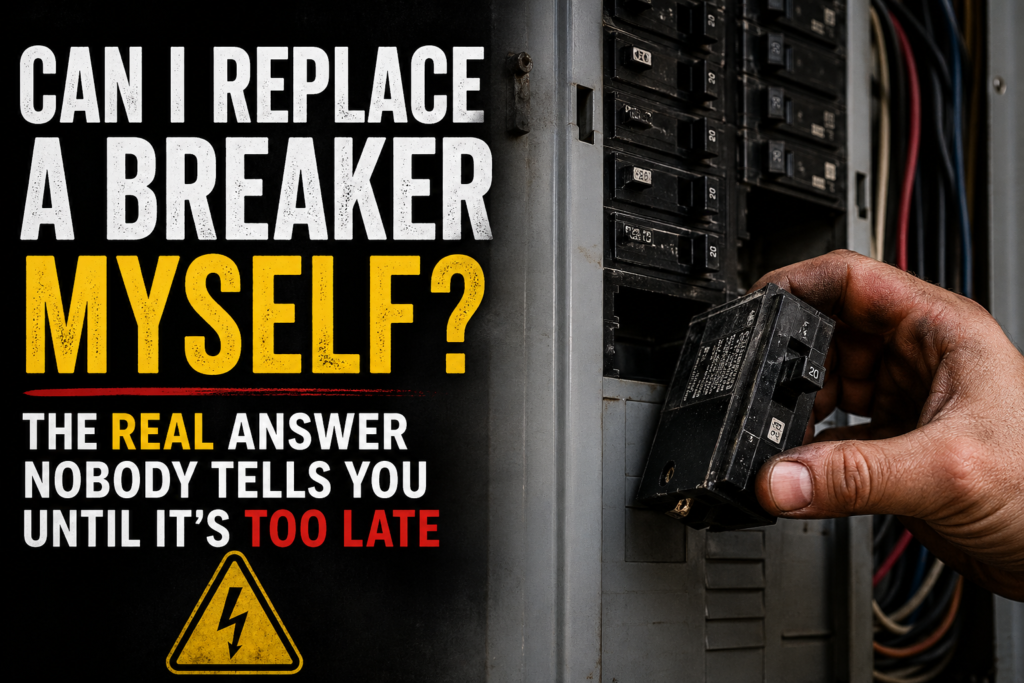
You’ve got a breaker that keeps tripping. Maybe it’s the one for your kitchen. Maybe it’s the AC. Maybe it’s the bathroom outlet that decided today was the day to quit. And you’re standing in front of your electrical panel at 9 PM on a Tuesday, screwdriver in hand, watching a YouTube video with 400,000 views titled “Replace Any Breaker in 5 Minutes.”
Here’s the thing about those videos. They’re not wrong. Technically, swapping a breaker is a simple mechanical process. Unclip the old one, clip in the new one, tighten a screw. But “technically simple” and “actually safe” are two very different universes. And the gap between them is where homeowners get hurt, houses burn down, and insurance claims get denied.
I’m not here to scare you into hiring me. I’m here to give you the full picture—the legal landscape across America, the real risks that don’t make it into DIY tutorials, the times when doing it yourself is genuinely fine, and the times when it absolutely isn’t. My name’s Jake. I’ve been a licensed electrician for sixteen years, licensed in three states, and I’ve seen the aftermath of both professional work and well-intentioned homeowner fixes.
Let’s talk about what “can I replace a breaker myself” actually means in the real world.
Can I Replace a Breaker Myself? The Legal Truth Nobody Explains
Before we touch a single wire, we need to talk about whether you’re even allowed to do this work. Because the answer isn’t “yes” or “no”—it’s “it depends where you live, what you own, and what kind of work you’re doing.”
The State-by-State Patchwork
America doesn’t have one electrical code. We have the National Electrical Code (NEC), which is a model standard published by the National Fire Protection Association. But the NEC isn’t federal law. States, counties, and cities adopt it piecemeal, modify it, or ignore it entirely. And they layer their own requirements on top.
Texas is often cited as a “DIY-friendly” state because of its Homeowner Exemption. The Texas Electrical Safety and Licensing Act technically allows homeowners to perform electrical work on their own primary residence . But here’s what most articles leave out: cities across Texas—especially in the Dallas-Fort Worth metroplex—require permits and inspections for panel work regardless of who does it. Fort Worth requires a sworn Homestead Affidavit. Arlington charges permit fees plus a $200 reinspection fee if your work fails. Keller requires a notarized Owner Affidavit and mandates inspection scheduling before 7 AM the day of . So yes, you can do the work. But you still need to pull a permit, pass inspection, and meet the same standards as a licensed electrician.
Washington State requires permits for essentially all electrical work, with very narrow exceptions. Homeowners can purchase permits, but the work must pass inspection by the Department of Labor and Industries or a city inspector . There’s no “just do it and forget about it” option.
Michigan allows homeowners to obtain permits for work on their own single-family home, but they must actually perform the work themselves—not hire an unlicensed handyman to do it under their name . The permit application requires affirmation that you have the necessary knowledge to perform code-compliant work.
California requires permits for most electrical work, including panel upgrades, new wiring, and EV charger installations. Homeowners can apply, but inspections are mandatory .
New York City is at the opposite extreme: only licensed master electricians may file permits for electrical work. Period .
Ohio (Toledo specifically) allows homeowners to pull permits if they meet three criteria: they own the home, they’re doing the work personally, and they occupy or will occupy the structure as their residence. But they explicitly state that the homeowner “must have the necessary knowledge to perform electrical work in compliance with codes” before attempting any work .
The Permit Reality Check
Here’s what “pulling a homeowner permit” actually involves in most jurisdictions:
- Application fee: $50-200 depending on the scope
- Plan or scope submission: You need to describe exactly what you’re doing
- Inspection scheduling: The inspector comes after completion (and sometimes during)
- Pass/fail: If you fail, you fix it and pay for reinspection
The inspection standard is identical whether you’re a homeowner or a master electrician. There’s no “homeowner discount” on code compliance. If your torque specs are wrong, your breaker brand is mismatched, or your wire routing violates code, you fail. And now you’re paying for a second inspection.
The Insurance and Disclosure Trap
This is where DIY electrical work can bite you years later. In Texas, Section 5.008 of the Property Code requires sellers to disclose any alterations made without required permits or not in compliance with building codes . If you replace a breaker without a permit and later sell your house, you must check “yes” on that disclosure. Buyers can demand price reductions, require remediation, or walk away entirely.
Worse: if you don’t disclose and a subsequent electrical failure occurs after closing, you can be sued for fraudulent concealment .
And then there’s insurance. After any electrical fire, insurance carriers send forensic investigators. If they trace the fire to panel work that was unpermitted, improperly executed, or used wrong parts, your claim can be denied entirely. You’re left paying for the rebuild out of pocket.
So when you ask “can I replace a breaker myself,” the technical answer might be yes. But the legal, financial, and practical answer is: only if you understand and accept the full regulatory framework where you live.
Can I Replace a Breaker Myself? What the Work Actually Requires
Let’s assume you’ve navigated the legal maze and decided to proceed. What does the actual work involve? And what do you need to know that YouTube tutorials gloss over?
The Tools Nobody Mentions
Those “5-minute” videos show a guy with a flathead screwdriver swapping breakers like he’s changing a lightbulb. Here’s what they don’t show:
Insulated screwdrivers rated for 1000V: Regular screwdrivers have plastic handles that aren’t rated for electrical work. If you slip and bridge hot to ground, the handle can conduct. Professional insulated screwdrivers cost $30-60 each.
A calibrated torque screwdriver: The 2023 NEC requires every terminal connection to be tightened to manufacturer-specified torque values . Not “tight enough.” Not “snug.” A specific inch-pound measurement. Under-torqued connections loosen under thermal stress. Over-torqued connections strip threads or crack the breaker body. A proper torque screwdriver costs $100-300. Most homeowners don’t own one. Many electricians didn’t own one until the 2023 code made it mandatory.
A non-contact voltage tester AND a multimeter: You need to verify dead circuits. Twice. Non-contact testers can give false negatives if batteries are weak. Multimeters can be misused if you don’t know which setting to use. Both are essential, and neither is optional.
Arc-flash rated PPE: If you’re working on a live panel (which you shouldn’t, but sometimes must), you need face shields, insulated gloves, and flame-resistant clothing. Arc flash temperatures reach 35,000°F—four times hotter than the surface of the sun.
The Compatibility Minefield
This is where DIY replacements go wrong most often. Breakers are not interchangeable between brands. A Square D breaker physically fits into a Siemens panel? That doesn’t mean it’s safe. It means it’s dangerous.
Every panel manufacturer designs their bus bar geometry—the metal bars that the breaker clips onto—with specific dimensions, angles, and spring pressures. A breaker from another brand might clip in but make poor contact. That poor contact creates resistance. Resistance creates heat. Heat creates arcing. Arcing creates fires.
Even within brands, there are different lines. Square D makes QO breakers and Homeline breakers. They’re not cross-compatible. Siemens makes QP and QT series. Eaton makes BR and CH series. Using the wrong one voids the panel’s UL listing and creates a fire hazard .
And then there’s the modern requirement for AFCI (Arc Fault Circuit Interrupter) and GFCI (Ground Fault Circuit Interrupter) breakers. These are significantly more complex than standard breakers. They have neutral pigtails that must be connected to the panel’s neutral bus. They have specific wiring configurations. They require testing after installation. A homeowner who swaps a standard breaker for an AFCI without understanding the circuit configuration can create immediate nuisance tripping—or worse, a false sense of protection.
The Multi-Wire Branch Circuit Problem
Older homes often have multi-wire branch circuits (MWBCs)—two hot wires sharing a neutral. This was a common way to save wire in the 1960s-1980s. Modern AFCI breakers monitor current balance and will trip immediately on an MWBC if not properly configured. Correcting this requires identifying the shared neutral, installing handle ties, and sometimes rewiring. It’s beyond the scope of a simple breaker swap, and it’s not something most homeowners can diagnose .
The Live Bus Bar Reality
Here’s the part that makes professional electricians nervous about homeowner panel work: even with the main breaker off, parts of your panel may still be energized.
The main breaker shuts off power to the branch circuits—the breakers you see. But the bus bars that those breakers clip onto are fed directly from your utility service. Unless your meter is pulled (which requires the utility company), those bus bars are live at all times. Every time you clip a breaker onto them, you’re working within inches of 240 volts with enough available current to kill you instantly.
Professional electricians are trained to work in these conditions. We know exactly where to place our hands, how to position our bodies to avoid bridging phases, and what to do if something goes wrong. Homeowners watching a YouTube video do not have this training.
Can I Replace a Breaker Myself? The Safety Risks in Plain Language
I want to be very clear about what can go wrong. Not to scare you, but because “informed consent” applies to electrical work too.
Electric Shock
Household voltage in America is 120/240 volts. That’s enough to stop your heart if current passes through your chest. The danger isn’t just touching a hot wire—it’s touching a hot wire while also touching ground, or while touching another hot wire from the opposite phase.
Panel work puts your hands in close proximity to multiple energized parts simultaneously. A slip of the screwdriver. A hand bracing against the panel frame while reaching for a wire. A dropped tool that bridges two bus bars. Any of these can create a path through your body.
The statistics are sobering. Electrical injuries in DIY home improvement projects send thousands to emergency rooms annually. Fatalities are less common but entirely preventable.
Arc Flash
An arc flash is an electrical explosion. It happens when current flows through air between two conductors—usually because something dropped, slipped, or bridged them. The temperature can exceed 35,000°F. The sound is like a gunshot. The light can blind you. The pressure wave can throw you across the room. The molten metal spray can cause third-degree burns.
Arc flash is the reason electricians wear face shields and flame-resistant clothing. It’s the reason we never work alone on live panels. It’s the reason we plan our movements before we touch anything. Homeowners don’t have this equipment, this training, or this mindset.
Fire From Improper Installation
The most common DIY breaker mistake is also the most dangerous: the wrong breaker, poorly connected, generating heat that builds over days or weeks until something ignites.
A loose connection on a bus bar can arc intermittently for months before failing completely. Every arc event damages the metal slightly, increasing resistance, increasing heat. The plastic breaker body degrades. The wire insulation cooks. Eventually, the breaker fails to trip under overload because its internal mechanism has been heat-damaged. The wires overheat. The wall catches fire.
I’ve opened panels where DIY breaker replacements were done with the wrong brand, under-torqued, or double-tapped with two wires under a terminal designed for one. In every case, the homeowner said “it worked fine for a while.” That’s the nature of electrical failures—they incubate.
The Wrong Breaker for the Wire
This is subtle but critical. Breakers protect wires, not devices. A 20-amp breaker protects 12-gauge wire. A 15-amp breaker protects 14-gauge wire. If you install a 20-amp breaker on a circuit with 14-gauge wire (because “the old one kept tripping and I wanted more capacity”), you’ve created a fire hazard.
The 14-gauge wire will overheat before the 20-amp breaker trips. The insulation will melt. The wire can arc inside the wall. This is one of the most common DIY mistakes, and it’s completely invisible until it fails catastrophically.
Can I Replace a Breaker Myself? When DIY Is Actually Reasonable
I’m not anti-DIY. I’m anti-uninformed-DIY. There are situations where replacing a breaker yourself is genuinely acceptable, provided you have the right conditions.
The Ideal DIY Scenario
- You own a modern panel (post-2000, major brand, good condition)
- You’re replacing a standard breaker with an identical breaker (same brand, same model, same amperage)
- The main breaker works and you can de-energize the branch circuits
- You have proper tools (insulated screwdriver, torque screwdriver, voltage tester, multimeter)
- Your jurisdiction allows homeowner electrical work and you’re willing to pull a permit if required
- You understand the panel layout and can identify the correct breaker
- The circuit is straightforward (no MWBC, no aluminum wiring, no GFCI/AFCI complexity)
- You’re comfortable working near live parts and have a helper nearby
If all of these are true, you can probably do this safely. But “probably” is doing a lot of work in that sentence.
The Step-by-Step (For Those Who Proceed)
- Turn off the main breaker and verify with a non-contact tester and multimeter that the branch circuits are dead
- Remove the panel cover carefully—it’s heavy and awkward
- Identify the failed breaker by its position and labeling
- Verify the breaker brand and model—check the panel label or existing breakers
- Obtain the correct replacement from a hardware store or electrical supply house
- Wear safety glasses and insulated gloves
- Remove the wire from the old breaker by loosening the terminal screw
- Remove the old breaker by unclipping it from the bus bar (firm outward pull)
- Install the new breaker by aligning it with the bus bar stab and pressing firmly until it clips
- Connect the wire to the new breaker’s terminal
- Torque the terminal to manufacturer specification using a calibrated torque screwdriver
- Verify no loose wires or tools are left inside the panel
- Replace the cover
- Turn on the main breaker
- Test the new breaker by turning it on and verifying the circuit works
- Test GFCI/AFCI breakers using their test buttons if applicable
If any step feels uncertain, stop and call a professional.
Can I Replace a Breaker Myself? The Times You Absolutely Should Not
There are situations where DIY breaker replacement is not just risky—it’s potentially catastrophic. If any of these apply to your situation, call a licensed electrician.
Federal Pacific Electric (FPE) or Zinsco Panels
If your panel says Federal Pacific Electric, Stab-Lok, Zinsco, or GTE-Sylvania, do not touch anything inside it. These panels have documented, widespread safety defects.
FPE Stab-Lok breakers fail to trip during overcurrent events at rates of 60-65% according to IEEE research . Some breakers remain energized even when switched to “OFF.” These panels are estimated to cause approximately 2,800 residential fires annually .
Zinsco panels have aluminum bus bars that corrode at breaker connections, generating heat that melts breakers onto the bus bar. Removing a Zinsco breaker can snap the brittle bus bar, exposing live 240-volt components .
No reputable electrician will install replacement breakers in these panels. The only safe remediation is complete panel replacement by a licensed professional.
Panels That Are Wet, Corroded, or Damaged
If you open your panel and see rust, water stains, corrosion on bus bars, melted plastic, or burn marks, do not proceed. These conditions indicate systemic problems that a breaker swap won’t fix. The panel needs professional evaluation and likely replacement.
Main Breaker or Service Disconnect Replacement
Replacing the main breaker—the one that shuts off power to your entire house—is fundamentally different from replacing a branch circuit breaker. The main breaker is connected to your utility service. The lugs that connect your service wires are always live unless the meter is pulled. Working on main breakers requires coordination with the utility company and specialized knowledge of service entrance wiring. This is never DIY territory.
Situations Where the Breaker Trips Immediately Upon Reset
If your breaker trips instantly when reset—even with everything unplugged—you have a hard fault (short circuit or ground fault) somewhere in the wiring. Replacing the breaker won’t fix this. The problem is downstream, possibly inside your walls. You need professional diagnostics to locate and repair the fault .
Aluminum Wiring Present
If your house was built between 1965 and 1973, you may have aluminum wiring. Breaker replacement in aluminum-wired circuits requires special connectors, anti-oxidant compound, and knowledge of aluminum’s unique properties. Standard breakers and connections designed for copper can create dangerous galvanic corrosion and loose connections over time.
You Don’t Know What You’re Looking At
This sounds obvious, but it’s the most important point. If you open your panel and feel confused by what you see—if you can’t confidently identify the main breaker, the bus bars, the neutral bus, the ground bus, and the specific breaker you’re replacing—close the panel and call an electrician. Confidence without competence is how people get hurt.
Can I Replace a Breaker Myself? What Professionals Do Differently
When you hire a licensed electrician for breaker replacement, you’re not just paying for the mechanical act of swapping a part. You’re paying for a comprehensive service that includes things most homeowners never consider.
Diagnostic Work
A tripping breaker is a symptom, not a disease. A professional starts by diagnosing why the breaker tripped. We use clamp meters to measure actual circuit load. We test insulation resistance to identify wiring faults inside walls. We inspect the panel for broader issues—double-tapped breakers, loose connections, heat damage, code violations .
Sometimes the breaker is genuinely worn out and needs replacement. Often, the breaker was doing its job perfectly, protecting against an overloaded circuit or a wiring fault. Replacing the breaker without fixing the underlying problem removes your protection.
Load Calculations
If your breaker keeps tripping because the circuit is overloaded, a professional performs a load calculation to determine if the circuit can handle your actual usage. If not, we discuss options: redistributing loads, adding circuits, or upgrading service. We don’t just install a bigger breaker and hope for the best—that’s how fires start.
Code Compliance and Upgrades
Professional work includes ensuring code compliance, which often means upgrades you didn’t know you needed. The 2023 NEC requires AFCI protection in most living spaces, GFCI in wet areas, and tamper-resistant outlets in most locations. A simple breaker replacement might trigger requirements for additional protection that a homeowner wouldn’t know to install.
Torque Verification
We torque every connection to manufacturer specification using calibrated tools. We document the values. This isn’t obsessive—it’s what the code requires, and it’s what prevents the loose connections that cause fires.
Permits and Inspections
We pull permits when required. We schedule inspections. We ensure the work passes. This protects you legally, financially, and physically. When you sell your house, the work is documented. When your insurance company asks, you have proof of professional installation.
Warranty and Liability
Licensed electricians carry insurance. If something goes wrong, their policy covers it. If a DIY job goes wrong, you’re paying for it. Professional work also comes with warranties—typically one year on labor, longer on materials.
Can I Replace a Breaker Myself? Cost Reality Check
Let’s talk numbers, because this is often the deciding factor.
DIY Costs
- Breaker: $10-50 depending on type (standard vs. AFCI/GFCI)
- Tools (if you don’t own them): $150-400 for insulated screwdrivers, torque screwdriver, voltage tester, multimeter
- Permit: $50-200 depending on jurisdiction
- Time: 2-6 hours including research, shopping, work, and cleanup
- Risk: Potential for injury, fire, code violations, insurance issues, disclosure problems
Professional Costs
- Service call + diagnostic: $75-150
- Single breaker replacement: $150-300 total (including parts and labor)
- AFCI/GFCI breaker upgrade: $200-400
- Main breaker replacement: $400-2,000
- Full panel replacement (if needed): $1,500-4,500+
The professional route for a simple breaker replacement costs roughly $150-300. The DIY route, if you factor in tool purchases and permit fees, might save you $50-100. But you’re trading that savings for all the risks we’ve discussed.
If you already own the tools and your jurisdiction doesn’t require permits, DIY might save $100-200. Whether that savings is worth the risk is a personal decision—but it should be an informed one.
Can I Replace a Breaker Myself? The Insurance and Resale Perspective
I want to expand on something critical that most DIY guides ignore: the long-term consequences of unpermitted or non-professional electrical work.
Homeowner’s Insurance
Standard homeowner’s policies cover electrical fires—but they investigate causes. If a forensic electrician determines that the fire originated at a DIY breaker replacement that was improperly installed, used wrong parts, or violated code, your insurer can deny the claim. This isn’t theoretical; it happens.
Some policies explicitly exclude damage from “work performed by unlicensed persons.” Read your policy. Know what you’re covered for.
Home Sales and Disclosures
In most states, you’re legally required to disclose unpermitted work when selling your home. This includes electrical work you performed yourself. The disclosure affects buyer confidence, offer amounts, and negotiation leverage.
Even if you don’t disclose, home inspectors routinely open panels. They note breaker brands, installation quality, permit stickers, and code compliance. A mismatched breaker, missing torque specs, or unpermitted work will be flagged. The buyer will demand remediation, often at professional rates, before closing.
Peace of Mind
This is intangible but real. When you hire a professional, you know the work is correct. You don’t lie awake wondering if that slight warmth you felt near the panel is normal. You don’t second-guess every breaker trip. You don’t worry about what the home inspector will find in five years.
Can I Replace a Breaker Myself? My Honest Recommendation
After sixteen years of doing this work, here’s my straight answer:
If you’re electrically knowledgeable, have proper tools, understand your local code requirements, and are working on a modern, safe panel with a straightforward circuit—yes, you can replace a breaker yourself. It’s mechanically simple. The risks are manageable if you’re truly prepared.
But if any of those conditions aren’t met—if you’re uncertain about the panel brand, if you don’t own a torque screwdriver, if your jurisdiction requires permits you don’t want to pull, if the breaker trips immediately upon reset, if you see any damage or corrosion, if you have FPE or Zinsco, if you have aluminum wiring, if you’re not 100% confident in what you’re doing—call a licensed electrician.
The cost of professional service for a simple breaker replacement is $150-300. The cost of getting it wrong can be your house, your health, or your life. That’s not dramatic language. That’s the reality of working with systems that can deliver 10,000 amps of fault current in an instant.
Electrical work isn’t like plumbing or carpentry, where mistakes are usually visible and fixable. Electrical mistakes can smolder inside walls for months before revealing themselves. They can kill you before you know anything is wrong. Respect the system. Know your limits. And when in doubt, make the call.
Jake is a licensed master electrician with sixteen years of experience in residential and light commercial electrical work across multiple U.S. states. He specializes in electrical safety, code compliance, and homeowner education.